Why Per-Square-Foot Pricing Falls Apart
Published per-square-foot bands contradict each other by roughly three to one, and correctly-priced jobs land on both sides of all of them. That is not a small disagreement. It means the number is not a method.
It is the first number anybody offers you, and it is the most confidently wrong advice in the trade.
Ask what to charge for cleaning a commercial space and somebody will give you a range in cents per square foot. It sounds rigorous. It has a unit in it. It feels like the kind of thing a professional would know.
Then you look up a second source and get a different range. And a third, and a fourth, and the spread across them is roughly three to one.
That is not experts disagreeing at the margins. A three-to-one spread means the number is not measuring what people think it is measuring.
What the number leaves out
Square footage is one input to a bid. It is not the bid. Everything that actually determines how long a building takes is invisible in it.
What is in the space. Ten thousand square feet of open warehouse and ten thousand square feet of cubicles, offices and corridors are completely different jobs. One is a straight run with a machine. The other is a hundred small obstacles, edges, and doorways.
How many restrooms. This is the single biggest driver in most commercial buildings, and it correlates weakly with floor area. A small office with four restrooms takes longer than a larger one with two.
Floor type. Carpet, tile, polished concrete, and vinyl clean at different speeds with different equipment.
Layout. Three floors with one slow elevator is not the same building as one floor. Neither is a site where the trash room is across the parking lot.
Standard. A daily maintenance clean and a detailed clean are different work in the same room.
Two buildings of identical square footage can differ by a factor of two in hours. No per-square-foot figure can see that, which is why every published band has to be wide enough to be useless.
Build from hours
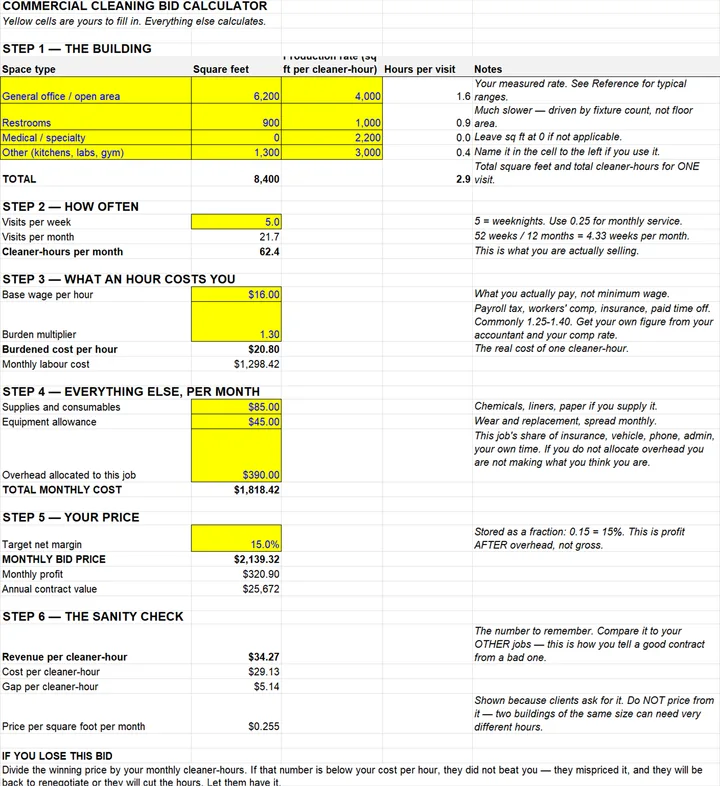
The model that actually works has four inputs, and square footage is only the first.
1. Cleanable square footage — what you actually service, not the gross area.
2. Production rate — square feet one cleaner covers in an hour, for this kind of space.
3. Frequency — visits per month.
4. Loaded hourly cost — what an hour costs you, all in.
Area divided by production rate is hours per visit. Times frequency is hours per month. Times your loaded cost is your monthly cost. Add overhead recovery and margin, and you have a bid.
The difference is not cosmetic. Every one of those numbers is something you can check, measure, and improve. "Nine cents a square foot" is a number you can only accept or reject.
Production rates are estimates, and should be labeled as such
Production rate is where the real uncertainty lives, and it deserves to be handled honestly.
Published rates are averages drawn from crews that are not yours, in buildings that are not this one, with equipment you may not have. They are a reasonable starting hypothesis and nothing more.
A tool or a spreadsheet that presents a production rate with the same confidence as the square footage you measured yourself is lying to you by omission. The area is a fact. The rate is a guess until you check it.
The fix is small: on your first two or three contracts, record the real clock time and the real area. Two measurements from buildings you have actually cleaned beat every table in print, because they carry your pace, your equipment, and your standard.
After that you are bidding from history rather than from an average, and your bids get tighter and more competitive at the same time — because you stop padding to cover uncertainty you no longer have.
What the per-square-foot number is actually good for
One thing: a sanity check, at the end, after you have a real bid.
Divide your bid by the area. If the result is in a plausible neighborhood for your market, fine. If it is triple what everybody else charges, you have probably made an arithmetic error or misjudged the production rate — go back and look.
That is a genuinely useful check, and it is the opposite of building the price from the figure.
There is a specific failure worth naming here. A previous version of one of our own tools shipped a per-square-foot check with a units error in it — comparing a per-visit number to a per-month benchmark. Following that check would have told you to raise a perfectly good bid by an order of magnitude. It was wrong by a factor of ten, and it looked authoritative the entire time.
The rule that came out of it: no check compares unlike units, and every check names its unit in the label. A per-cleaner-hour figure gets compared to a per-cleaner-hour source. A per-visit figure gets compared to a per-visit source. If a check cannot state its unit, it does not belong in the tool.
The uncomfortable part
Building from hours takes longer than quoting a rate off a chart. You have to measure the building, judge the space, and know your own costs.
That is the job. The alternative is a number that is right by accident when it is right at all, on a contract you are committed to for twelve months.
Cents per square foot is how you check your work. It is not how you do it.