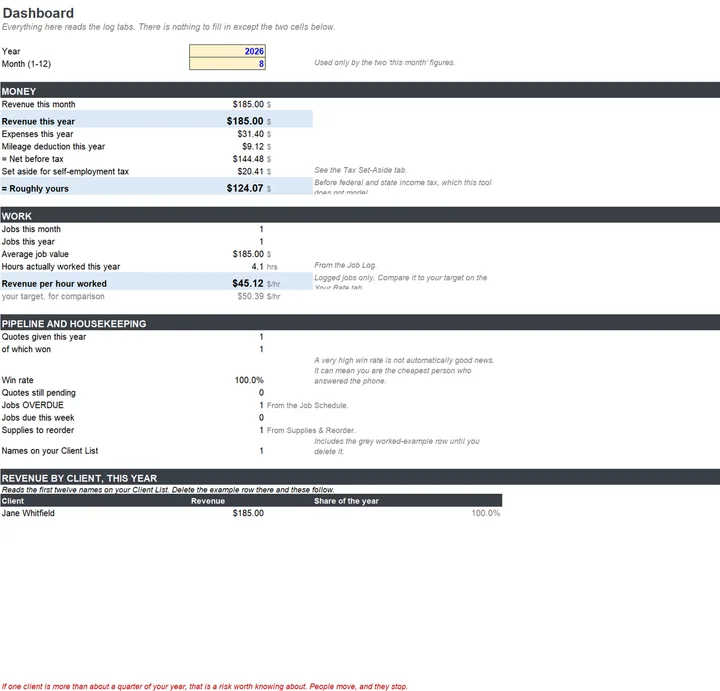
A High Win Rate Is Not Automatically Good News
If you win every job you quote, that is not proof you are good. It is usually proof you are cheap - and it is one of the few business numbers where a lower figure can be the healthier one.

Somebody says they win almost every job they quote, and it is always said with pride.
It should not be. A win rate near 100% is one of the clearest signals in small business, and the thing it usually signals is that you are the cheapest person who answered the phone.
What the number is actually measuring
Your win rate is the fraction of quotes that turn into work. It is a measure of the relationship between your price and your market — not a measure of your skill, your work, or how much people like you.
If it is very high, one of a few things is true:
- You are underpriced. Most common by a distance.
- You are quoting only where you were already the obvious choice — referrals, repeat clients, people who called you specifically. That is a healthy business but a meaningless win rate, because you were never really competing.
- You are turning away everything difficult before it becomes a quote, which is a legitimate strategy but means the number is telling you about your filtering, not your pricing.
If it is very low, something else is happening: your price is genuinely out of step, or you are quoting the wrong kind of work, or your quotes are arriving too slowly, or they are hard to say yes to.
Neither extreme is good news. The number is only useful once you know which situation you are in, and you cannot know that without a record of what you quoted and what happened.
The uncomfortable arithmetic
Run it and it stops being abstract.
Say you quote 40 jobs a year at $600 and win all 40. That is $24,000.
Now raise your price 20% to $720, and your win rate drops to 70%. You win 28 jobs, for $20,160.
That looks worse — until you count the cost of the work. If each job costs you $250 in time and materials, the first scenario leaves $14,000 after costs across 40 jobs. The second leaves $13,160 across 28 jobs.
Slightly less money, for twelve fewer jobs. Twelve fewer drives, twelve fewer setups, twelve fewer chances for something to go wrong, and a third of your capacity back.
Push the price a little further, or hold the win rate a little higher, and the higher price wins outright on both money and time.
This is why "I'm busy" and "I'm doing well" are not the same sentence, and why the busiest people in a trade are frequently not the best paid.
What to aim for
There is no universal right answer, but there is a useful range: somewhere around half to two-thirds is where most healthy service businesses sit when they are quoting genuinely competitive work.
That means losing a real number of jobs. It should feel slightly uncomfortable. If it never does, you are almost certainly leaving money on the table.
The exception worth naming: if most of your work is repeat business and referrals from happy clients, your win rate on those will be very high and that is exactly as it should be. Track those separately from cold quotes if you can, because mixing them produces a number that means nothing.
A quote nobody chased is not a lost quote
One distinction changes what the number is worth.
Most people record a quote as won or lost. But a large share of quotes are neither — they are simply unanswered. The customer did not say no. They got busy, or they were waiting on a spouse, or your email arrived on a bad day.
A quote nobody chased is not a lost quote. It is an unfinished one.
Counting those as losses makes your win rate look worse than it is and hides the actual problem, which is not your price but your follow-up. One short message a week after a quote — "just checking whether you'd like me to hold that slot" — converts a meaningful fraction of them, and costs nothing.
So track three states, not two: won, lost, and still pending. Then chase the pending ones before you conclude anything about your pricing.
What to write down
You need four fields per quote, and it takes fifteen seconds.
- The date you quoted
- Who it was for
- The amount
- The outcome: won, lost, or pending
That is it. From those four, the win rate calculates itself, this year against last year, and — more useful than either — you can see what you actually quoted over time. Most people badly misremember their own average quote.
If you want one more field, add a short note on why you lost. After ten of them a pattern usually shows up, and it is rarely "too expensive." More often it is that somebody else got there first, or the customer wanted something adjacent that you did not offer.
What this will not tell you
It will not tell you what to charge. It tells you how the market is responding to what you already charge, which is a different and more limited thing.
It also cannot see the jobs you were never asked to quote. If your price has drifted far enough that people stop calling, your win rate on the quotes you do give can stay high while the business quietly shrinks. Watch the number of quotes alongside the win rate; the two only mean something together.
And it has no opinion on whether a job was worth doing. A won job at a bad price is still a loss — you just find out later.