How to Raise Your Prices Without Losing Half Your Customers
Almost everybody waits too long, then raises too much at once, then apologizes for it. Done properly a price increase costs you a couple of clients and buys back a day a week.

Most people running a service business are underpriced, know it, and do nothing about it for two or three years.
The reason is not laziness. It is that a price increase feels like a single terrifying event with an unknown outcome, and it is easier to keep working than to find out. So the price stays where it was set — usually in a nervous first year, by somebody with no idea what the work actually cost.
Meanwhile fuel went up, insurance went up, and the equipment aged. Real income drops a little every year, invisibly, and you compensate by taking on more work.
Here is a way to do it that is uncomfortable for about a week.
First, find out what you are actually charging
Not what your rate card says. What each client actually pays, and what each job actually takes.
You will almost certainly find a spread you did not expect. The client you signed three years ago on a favor is paying 30% below the one you signed in March. The house that "only takes an hour" takes ninety minutes and has for a year. Somebody is getting a service you added and never charged for.
This step matters because it changes the question. "Should I raise my prices?" is vague and frightening. "Should the Hendersons still be paying 2023 rates for a job that now takes twenty minutes longer?" answers itself.
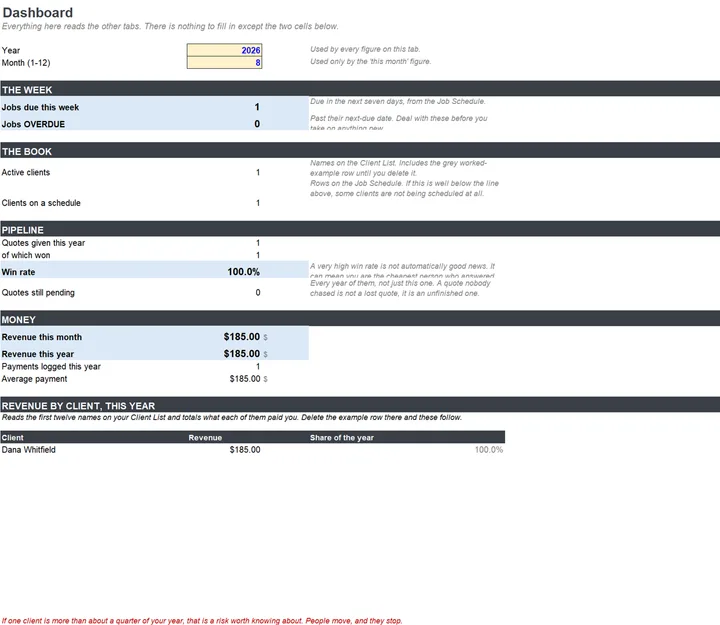
Total the year by client while you are in there. It is the same information and you will want it in a minute.
Raise the worst ones first, not everybody at once
An across-the-board increase is the version most people imagine, and it is the riskiest one. Every client gets the same news on the same day, so if you have misjudged the market you find out all at once.
Do it in order of how badly the price is wrong.
Start with the bottom quartile — the legacy rates, the ones that made sense when you had no work and a gap in the schedule. Those clients are getting the largest discount and are usually the least likely to leave, because they are also the ones who have had you longest and know what you are worth.
Then work upward over a few months. By the time you get to the recent, correctly-priced clients, you have real information about how your market responds, and you may find they need no increase at all.
Give notice, in writing, with a date
Thirty days is the norm and it is enough. Sixty if the client is commercial and has a budget cycle.
Put it in writing even if you would normally text. A short message with a specific date and a specific new price is easier to accept than a conversation, because it gives the client somewhere to put it — a thing to note in a calendar rather than a negotiation to have on the spot.
Say what is changing and when. Do not apologize, and do not over-explain.
Starting October 1, the price for the fortnightly service goes to $52. It has been at $45 since we started and my costs have moved since then. Everything else stays the same. Happy to talk it through if you want to.
That is the entire message. Notice what is not in it: no essay on fuel prices, no apology, no request for permission.
Do not justify it to death
The instinct is to build a case — insurance, fuel, the cost of everything. Resist most of it. One clause is plenty.
Long justifications signal that you think the increase needs defending, which invites a negotiation you did not want. Nobody sends a page of reasoning with a bill they consider fair. The people who accept a price increase without comment are the majority, and they accept it faster when it is delivered as information rather than as a plea.
Expect to lose some, and be honest about which ones
You will lose a few. Somewhere between one in twenty and one in ten is normal for a modest increase.
Here is the part that changes how it feels: look at which ones leave. It is almost always the price-sensitive, high-maintenance, scattered-location clients — the ones who were already your least profitable work, occupying slots that could hold better jobs.
Run the arithmetic before you panic. Forty clients at $45 is $1,800. Thirty-seven at $52 is $1,924. You are up on money and down three stops, which is a drive, a setup, and a pack-down you no longer do. That capacity is worth real money on its own.
If you lose nobody at all, the increase was too small. That is useful information too.
Two things that make it easier
Do it on a schedule, not on an emergency. Once a year, same month, everybody knows. A business that reviews prices annually is normal. A business that raises prices when it is desperate looks desperate, and clients can tell the difference.
Change something visible at the same time, if you honestly can. Not as a bribe — as a reason for the timing. A tightened schedule, a service added, a standard raised. It does not have to be large. It has to be true.
The one worth watching
While you have the year totaled by client, look at the top of that list.
If one client is more than about a quarter of your revenue, a price increase to them is a different kind of decision, because losing them is not losing 3% of your income. That concentration is worth knowing about before you send anything, and it is worth fixing regardless of pricing — not because they will leave, but because people move, budgets get cut, and businesses close.
You cannot see any of this from memory. It only appears when the year is totaled in one place, which is the actual argument for keeping the book at all.