How to Let a Client Go
Nearly everyone keeps a client too long, for a reason that is entirely rational and entirely wrong: the revenue is visible and the cost is not.

There is a client you think about on Sunday evening.
They are late paying, or the scope has crept, or every visit involves a conversation, or the job takes ninety minutes longer than you quoted and always has. You have been meaning to deal with it for about a year.
Nearly everybody keeps that client too long, and the reason is rational: the revenue is a number you can see, and the cost is a feeling you cannot. So the number wins, every time, until you are exhausted.
Make the cost a number and the decision takes ten minutes.
First, work out what they actually pay you
Take one client and be honest about all of it.
- Real time on site, not quoted time
- The drive, both ways, at the hour you actually go
- The admin — the extra calls, the rescheduling, the chasing
- Anything you do unpaid that has crept in
Divide what they pay by the total hours. That is what this client earns you per hour of your life.
Then compare it to your best client on the same basis.
The gap is usually startling. A client paying $180 who occupies four and a half hours all-in is earning you $40 an hour. One paying $140 for two hours is earning $70. The larger invoice is the worse client, and this is completely invisible without doing the arithmetic — which is exactly why people keep the wrong ones.
Which ones are actually the problem
Fix these — they are usually mispriced, not bad.
Slow-paying but otherwise fine. Terms problem. State a due date, chase on a schedule, and consider no new work until the balance clears.
Scope has grown. Price the extras at the next review, or drop them. They almost certainly do not know it happened.
Job takes longer than quoted. Re-quote it. The house changed, or your original estimate was wrong. Either way it is arithmetic, not character.
Let these go.
Chronically abusive or disrespectful. No price fixes this, and it costs you more than the job pays in a currency you cannot bank.
Repeatedly does not pay. Not slow — does not pay. Every additional job increases your exposure.
Wants a rate you cannot deliver at. If they refused the increase and you kept them anyway, you have agreed to work below cost indefinitely.
Consumes your capacity at the bottom of the list. When you are full and turning down better work, the least profitable client is not neutral. It is occupying a slot with a market value.
Raise the price first
The best version of letting a client go is usually one where you do not have to.
Quote them what the job is actually worth — the real time, the real drive, the scope as it now exists. Not a punishment number; the correct number.
Two outcomes and both are good. They accept, and the client stops being a problem. They decline, and they leave by their own decision, which is far easier for everybody than being released.
This also protects you against being wrong. If they cheerfully pay 30% more, the issue was your price, and you would have thrown away a good client over a fixable mistake.
The script
If it does come to ending it, do it in one short message. No history, no grievances, no list of the times they were difficult. Nothing you write here should be something they would be hurt to read aloud.
I'm restructuring my schedule for the fall and won't be able to keep the fortnightly service going past October 15. I wanted to give you plenty of notice so you can find somebody. Happy to recommend a couple of people if that helps.
That is the whole thing. Notice what it does: a clear end date, no blame, and an offer that costs you nothing.
Do not explain. Explanation invites negotiation, and you have already decided.
Do it properly
Give real notice. Two to four weeks for residential, whatever the contract says for commercial. You will see these people again — towns are small and referrals travel.
Finish the work you committed to. Every job up to the last date, at your normal standard. Walking away mid-arrangement is the thing people actually tell others about.
Collect first. Do not end the relationship with an unpaid balance outstanding. Chase the balance, then give notice.
Offer a name if you honestly can. It turns a rejection into a handover, and it genuinely helps somebody starting out who wants the work you are releasing.
Do it in a season, not in a temper
The best time is a scheduled review — new year, start of a season, contract renewal. A change made at a normal decision point is business. A change made at eleven on a Thursday night after a bad exchange is personal, and it reads that way.
Which is the strongest argument for having a review at all. If you look at every client once a year — what they pay, what they cost, how the job has drifted — the difficult ones surface as arithmetic rather than as resentment, and you deal with them a year earlier and much more calmly.
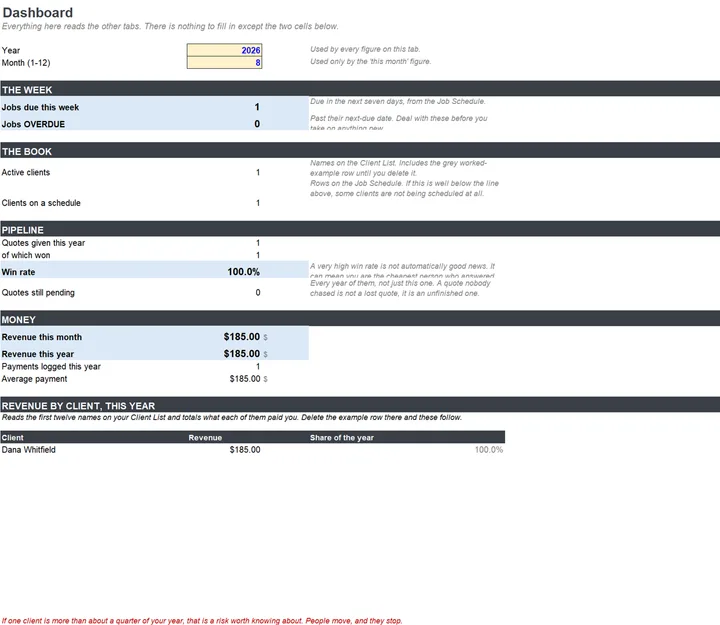
None of that is visible from memory. It only appears when the year is totaled in one place, one row per client.