How Much Should You Charge to Mow a Lawn?
Every pricing guide gives you a table of times. None of them tell you where the times came from. Here is the arithmetic, in full, so you can price from your own clock instead of somebody else's chart.

Ask this question anywhere and you will get a number back within a minute. Forty dollars. Sixty. A dollar a minute. Somebody will tell you what they charge in their town, somebody else will tell you that is too cheap, and none of it will help, because none of it is about your mower, your route, or your day.
The number you charge is not a matter of opinion. It falls out of three things: how long the lawn takes, what the stop costs you to reach, and what your business needs to earn per hour to survive. Two of those are arithmetic. Only the third is a judgment call.
Start with the part that can be known exactly
A mower cutting a strip as wide as its deck, at a steady speed, covers a calculable amount of ground. There is no estimating involved:
- Deck width in inches, divided by 12, is your swath in feet.
- Miles per hour times 5,280 is feet traveled per hour.
- Swath times feet per hour is square feet per hour.
- Divided by 43,560 gives you acres per hour.
Put together, the whole thing collapses to a single division, because 43,560 divided by 440 is exactly 99:
Acres per hour = deck inches × mph ÷ 99
That is not an industry estimate and it is not a manufacturer's claim. It is a unit conversion. A 48-inch deck at 4 mph gives you 48 × 4 ÷ 99 = 1.94 acres per hour, in theory.
In theory is doing real work in that sentence. You turn at the end of every pass. You overlap so you do not leave stripes. You go around the trampoline, the swing set, the flowerbed, and the dog. So you multiply by a site efficiency factor.
Exmark, who make commercial mowers, publish the same arithmetic from the other end: they use 99 for a theoretical 100% efficiency and 124 for a realistic 80%. Ninety-nine divided by 0.80 is 123.75. Their own documentation notes that many manufacturers quote 100% efficiency ratings for sales purposes. Believe the 80%. On a fenced suburban lawn with obstacles, believe rather less — 60% to 70% is more honest.
At 65% efficiency, that 48-inch deck at 4 mph is doing about 1.26 acres per hour. A quarter-acre lawn is roughly twelve minutes of mowing.
Twelve minutes is not what you sell
Here is where most pricing goes wrong. Twelve minutes of mowing is not twelve minutes of your day.
You also trim, you edge, you blow the clippings off the walk, you load and unload, and — the big one — you drive there. A stop that takes twelve minutes on the deck can easily take thirty-five minutes windshield to windshield.
Those are two completely different denominators, and mixing them up is how people end up working sixty-hour weeks for wages:
- Revenue per billable hour is the price divided by the time you spend working on the property.
- Take-home per windshield hour is what is left after costs, divided by the time between leaving the last stop and leaving this one.
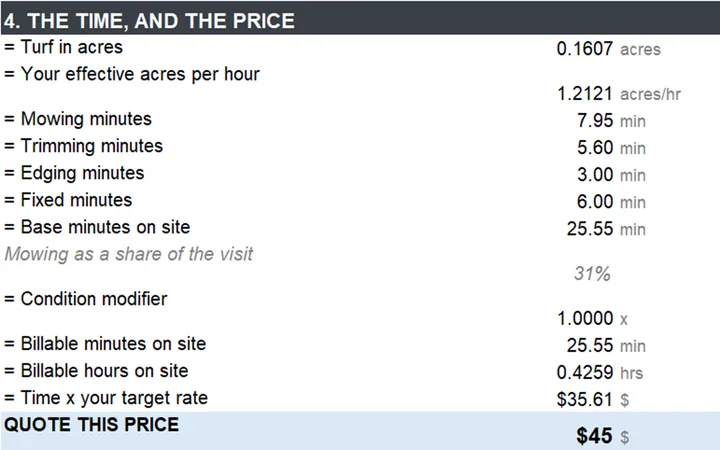
On a real residential route those two numbers can sit a factor of two apart. A worked example from the calculator: a $45 stop returns $105.66 per billable hour and $50.62 per windshield hour. Same job, same price, same machine. The gap is 52%.
The first number is the one people quote each other. The second is the one that pays your mortgage.
The drive is worth more than the price
Once you separate those two, something uncomfortable becomes obvious: the distance between your stops is worth more to you than the price on any one of them.
Take the same lawn, the same price, the same mower, and change only the drive between stops. At a four-minute drive, a full field day returns about $450.87 of take-home. At fifteen minutes, the identical work returns $292.37.
You did not mow worse. You did not charge less. You spent the difference in the truck.
This is why route density beats rate increases for most solo operators, and why "I'll take anything within thirty minutes" is a decision that costs real money every week. Turning down a scattered job is not turning down work. It is turning down a job that pays a third less than it looks like it pays.
Now the judgment call
The arithmetic gets you to time. Turning time into a price needs one number that is genuinely yours: what an hour of your working time has to earn.
Work it from the year, not the day. Add up twelve months of overhead — insurance, truck payment, maintenance, fuel, phone, blades, licenses, the lot — and recover it across the weeks you actually cut, which in most of the country is not fifty-two. Add what you intend to pay yourself. Divide by the billable hours you can realistically sell in that season.
That gives you an hourly rate. Multiply by the time the job takes and you have a price.
Then set a minimum stop charge, because on a residential route it is the minimum that most stops really sell at. A tiny lawn does not take zero minutes to service — you still drive there, unload, and set up. Below a certain size, the price stops being about the grass.
Do not forget the tax you owe on it
One more line most people leave out of their pricing entirely: self-employment tax. It runs to roughly 14.13% of net profit, and nobody withholds it for you. If your price covers your costs and your wage but not your tax, you have quietly agreed to pay for the privilege of working.
In the worked example above, the $45 stop produces $32.96 of pre-tax profit, $4.66 of self-employment tax, and $28.31 of take-home. That $4.66 was never yours. It only looked like yours because it was sitting in your account.
This is not tax advice and your situation may differ — talk to whoever prepares your return. But price as though the money is owed, because it is.
What this does not tell you
It will not tell you whether a price will win the job. It tells you what a job must earn for your business to work. Whether the customer says yes is a different question, and arithmetic has no opinion on it.
A correct price you lose is better information than a wrong price you win. Losing a bid tells you something about your market. Winning one that does not cover your costs tells you nothing at all, and you find out eighteen months later when the mower needs replacing and there is no money to do it.