What Should You Charge to Clean a House?
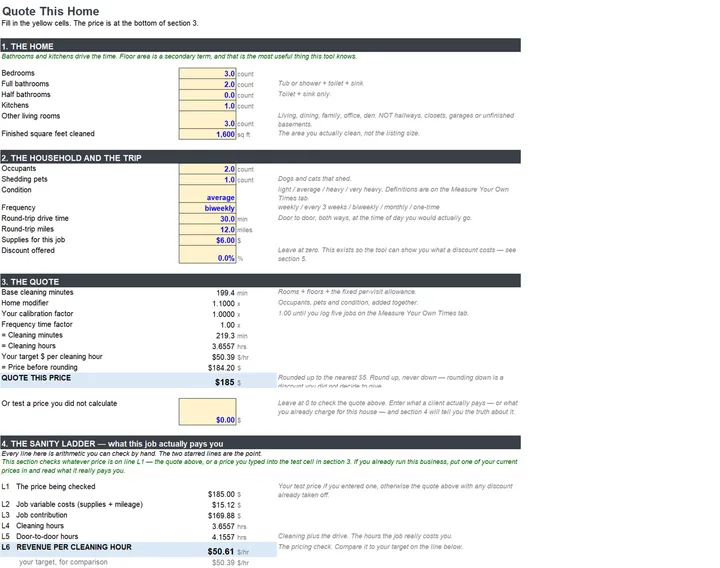
Per-room and per-square-foot pricing both fall apart on real houses, because neither one knows how dirty the house is or how far away it is. Price from the clock instead.
Two houses, both three bedrooms, both about 1,600 square feet. One takes two hours and ten minutes. The other takes four hours, and you leave feeling like you undercharged by half.
That is the entire problem with house cleaning prices. The variable that matters most — condition — is invisible in every pricing method people reach for first.
Why the two common methods fail
Per room. Fifty dollars for the first bedroom, thirty for each additional, extra for bathrooms. It is easy to quote on the phone, which is why everybody starts here. It also assumes every bedroom is the same bedroom, which they are not. A guest room nobody has entered in a month is eight minutes. A teenager's room is not eight minutes.
Per square foot. Sounds more rigorous. It is not. Published per-square-foot bands for residential cleaning contradict each other by roughly three to one, and correctly-priced jobs land on both sides of all of them. Square footage does not know about the dog, the stairs, or the fact that this family cooks properly every night.
Neither method is useless — they are both reasonable sanity checks after you have a price. Neither is a way to build one.
Price from the clock
The only thing you are actually selling is your time, so build the quote out of time.
Every room has a realistic minute count for a standard clean. A bathroom is not a bedroom. A kitchen is not a hallway. Start from a room-minute table, and be honest that a generic table is a scaffold — it was not measured on your work, in this house, at your standard.
Then apply the two multipliers that actually move the number:
Condition. Light, standard, or heavy. This is the biggest single factor and the one that makes per-room quoting fail. A heavy first clean can be double a standard maintenance visit on the identical house.
Frequency. A weekly house stays clean between visits. A quarterly house does not. The same address can be a two-hour job on a fortnightly schedule and a four-hour job twice a year.
Sum the minutes, apply the multipliers, and you have a time. That is the part of the quote you can defend.
Add the drive, because it is not free
Then add the part almost everyone leaves out.
Getting there costs you. So does the ten minutes of loading, the walk from the parking spot, and the drive to the next stop. If you quote two hours and the job occupies three and a half hours of your day, you are earning your quoted rate on 57% of your working time.
Two different numbers, and they are very far apart:
- Revenue per billable hour — the price divided by hours spent cleaning.
- Take-home per windshield hour — what is left after costs, divided by the time from leaving the last house to leaving this one.
Quote from the first and live on the second. When somebody asks you to add a house forty minutes across town "at the same rate," those two numbers are the reason the answer should usually be no.
Enter the drive at the time of day you would really go, not at six in the morning with no traffic. The drive is the largest hidden cost in residential cleaning, and the estimate is only as honest as that one number.
Set the rate once, then stop arguing with yourself
Turning time into money needs one number that is genuinely yours: what an hour of your working time has to earn.
Work it from the year. Twelve months of overhead — insurance, supplies, vehicle, phone, licensing — recovered across the hours you can actually sell. Add what you intend to pay yourself. That is your target hourly rate.
Set it once a season and stop renegotiating it in your head on every call. The point of having a rate is that the quote stops being an emotional decision made under pressure while somebody waits on the phone.
And set a minimum charge. A small apartment still costs you the drive, the setup and the pack-down. Below a certain size the price stops being about the floor area.
Your first five jobs are worth more than any table
Here is the part that separates people who get good at this from people who guess for years.
On your first five jobs, write down what actually happened: the house, the condition, the price you quoted, and the real clock time. Not your estimate — the truth.
After five, you have something no chart can give you: your own times, at your own standard, with your own equipment. Your quotes get tighter and more competitive at the same time, because you stop padding to cover uncertainty you no longer have.
Until you do that, every time estimate you use is an educated guess. That is not a criticism of estimating — it is the single largest source of error in residential pricing, and it is the one you can fix in about a month.
Two things a price cannot tell you
It cannot tell you whether you will win the job. It tells you what the job has to earn for your business to work. Whether the customer says yes is a separate question about your market, and no spreadsheet has an opinion on it.
It also does not know your market. A three-bed in rural Ohio and a three-bed in San Francisco produce the same time estimate. What differs is your target rate, and you set that yourself.
That is not a limitation to apologize for. It is the honest shape of the problem. A tool that claimed to know what people in your town will pay would be making it up.
And the tax nobody withholds
Self-employment tax runs to roughly 14.13% of net profit. If your price covers your supplies and your wage but not the tax on the profit, you have agreed to pay for the privilege of working, and you will find out in April.
Price as though the money is owed, because it is. This is not tax advice and your situation may differ — talk to whoever prepares your return — but do not let that bill be a surprise twice.