What to Charge for Post-Construction Cleaning
Post-construction is the most commonly underpriced job in cleaning, and the reason is structural: it is three jobs, on somebody else's schedule, with dust that comes back after you leave.
A builder asks what you would charge to clean a house they have just finished. It is 2,200 square feet, it is empty, and empty sounds easy.
It is not easy, and it is the most commonly underpriced job in the trade. Not because people are careless — because the job has three properties that no ordinary cleaning quote accounts for.
Why it is different
Dust comes back. Drywall dust is fine enough to stay airborne for hours and settles out of the air after you have wiped. You will clean the same surface more than once, and a first-timer does not budget for that.
You are on somebody else's schedule. The trades are supposed to be finished. Frequently one is not. Somebody arrives to fix a door while you are cleaning, and creates work behind you.
It is three jobs, not one. The industry generally splits it, and understanding the split is most of the pricing problem.
The three phases
Rough clean. During construction, after framing and drywall. Debris removal, sweeping, clearing so the next trades can work. Not detail work — volume work.
Final clean. After the trades are out. The real job: dust from every surface, inside cabinets and drawers, windows, fixtures, appliances, floors. This is what most people mean by post-construction cleaning.
Touch-up. Just before handover or walkthrough. Usually short. Catches the settled dust and whatever the last trade left.
If somebody asks for "a post-construction clean," ask which. Quoting a final clean and then being expected to have done the rough is a conversation that goes badly in a hallway with a builder who is already late.
What consumes the time
In rough order:
Repeat dusting. Plan for surfaces twice. Some ceilings and high ledges three times.
Inside everything. Cabinets, drawers, closets, the medicine cabinet, inside the oven and dishwasher. In a normal clean these are excluded or occasional. Here they are all included, in every unit, and they are individually slow.
Windows. Interior glass plus frames, tracks and sills — the tracks hold construction debris and are genuinely slow. Stickers and labels on glass and appliances are their own category of tedious.
Paint, adhesive, grout haze. Splatter on floors and fixtures, tape residue, mortar haze on tile. Removing these is closer to detail work than cleaning, and it is where hours vanish.
Debris. Even after the builder's cleanup there is more. Find out who is hauling it before you quote — if it is you, that is a dump run and a fee.
Fixtures and vents. Light fixtures, vent covers, ceiling fans. All dusty, all overhead, all slow.
How to price it
Not per square foot. Published per-square-foot figures for post-construction contradict each other by wide margins, and correct quotes land on both sides of all of them. Square footage does not know how many bathrooms there are, how much paint is on the floor, or whether the tile is hazed.
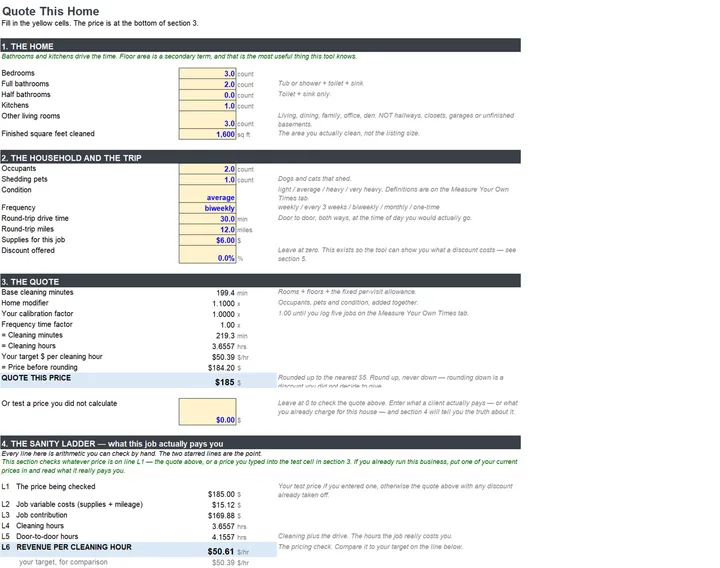
Hourly with a cap, on your first several. Until you have data of your own:
$60 an hour, estimated 22 to 26 hours across two people. I'll stop at 30 and we'll talk about anything remaining.
That protects both sides. The builder is not exposed to an open meter; you are not swallowing a house that is worse than the walkthrough suggested.
Expect a rate above your normal residential figure. The work is harder, dirtier, harder on equipment, and carries more risk of damaging new finishes.
Then flat-quote once you have history. After three or four, you will know what a comparable build takes and can quote a number, which builders prefer.
Walk it, and walk it late
Never quote post-construction from a plan or a photograph. Ever.
And walk it as close to the start as you can. A walkthrough two weeks early describes a different building — more trades have been through, more has been installed, more has been spilled.
While you are there, check the things that are not cleaning: is there power, is there water, is there a working bathroom, where do you park, is there a lift or are you carrying equipment up three floors. Any one of those can add hours.
Exclusions belong in writing
More important here than on any other job type, because the boundary between construction and cleaning is genuinely blurry.
Name them: exterior windows, debris hauling, anything requiring a lift, paint touch-up, scratched or damaged surfaces, appliance installation, and anything the trades were meant to remove.
And add the condition that matters most:
This quote assumes all trades are finished and the site is clear of construction materials. If work is still in progress the schedule and price will need revisiting.
That single sentence is the difference between a firm quote and an open commitment, because "the trades are finished" is the assumption most likely to turn out false.
Two things about builders as clients
Payment terms are commercial. Net 30 or worse, sometimes tied to the builder being paid themselves. Ask before you sign, and budget for the gap — you will buy supplies and possibly pay somebody long before the money arrives.
They are excellent repeat clients if you are reliable. A builder who has found a cleaner who turns up, finishes on the date, and does not need chasing will use you on every project. The relationship is worth more than any individual job, which is an argument for quoting it properly rather than cheaply — a price that loses you money once will lose it on every house they build.
Track the actual hours
Whatever you quote, record what it really took, split by phase and by what caused the overrun.
After three jobs you will price these from your own history rather than from a table, and your quotes get tighter and more competitive at once — because padding is a tax you pay for uncertainty, and you will no longer have it.