What Records Do You Actually Need to Keep?
Most people keep the wrong things carefully and the right things not at all. A drawer full of fuel receipts and no record of what was quoted is the usual shape of it.

The mental image is a shoebox. Receipts going in all year, an accountant sorting them in April, some kind of number emerging.
That picture is wrong in an interesting way: it keeps the least useful records carefully and the most useful ones not at all. A drawer full of gas receipts and no record of what you quoted, who paid when, or how long a job took is the usual shape of a small business's paperwork, and it is close to the exact inverse of what would help.
The two different jobs records do
Substantiation. Proving a number if somebody asks. This is what the shoebox is for, and it matters.
Running the business. Answering questions in November while there is still time to act on the answer.
Both matter. Only the second one makes you money, and it is the one almost everybody skips.
What you genuinely need to retain
Income records. Invoices issued, and what actually came in — dates and amounts. If you take cash or cards at the job, those count and they are the ones most likely to go unrecorded.
Expense records with proof. A bank line proves money left. A receipt proves what it bought. For most costs the statement plus a note is workable; for larger purchases keep the actual receipt.
Mileage log. Date, odometer or miles, destination, business purpose. Kept at or near the time of the trip — a log reconstructed in April is on much weaker footing and, more practically, undercounts badly.
Asset records. What you bought, when, and for how much, for anything substantial — vehicle, floor machine, mower. These matter for depreciation and again when you sell or replace.
Bank and card statements for the business account.
Contracts and agreements. What you agreed with each client — scope, frequency, price, start date.
Payroll records, if you have employees. These have their own retention rules and are worth asking about specifically.
How long
The general guidance for tax records is a few years from filing, with longer periods in specific circumstances — and the specifics genuinely vary by situation. Employment tax records have their own timeframe. Records relating to an asset need to survive as long as you own it, plus the period after you dispose of it.
That is the honest state of it: the periods are not something to take from an article, and your accountant can tell you in one conversation.
The practical answer is easier. Digital records cost nothing to keep, so keep everything, indefinitely. The whole retention question exists because paper is bulky. A folder per year on a drive with a backup removes the problem entirely, and it is cheaper than the twenty minutes you would spend working out what you are allowed to throw away.
Digital is fine, and better
Photographs of receipts are generally acceptable, and they solve the real failure mode: thermal receipts fade to blank within a year or two, which means the shoebox contains a lot of empty paper by the time anybody looks.
Photograph it at the counter. Same-day, in the same motion as the purchase.
Have a backup that is not the phone. A phone in a bucket of water is a common and entirely foreseeable way to lose a year of records.
The records nobody keeps, which are the useful ones
Here is where the shoebox model fails.
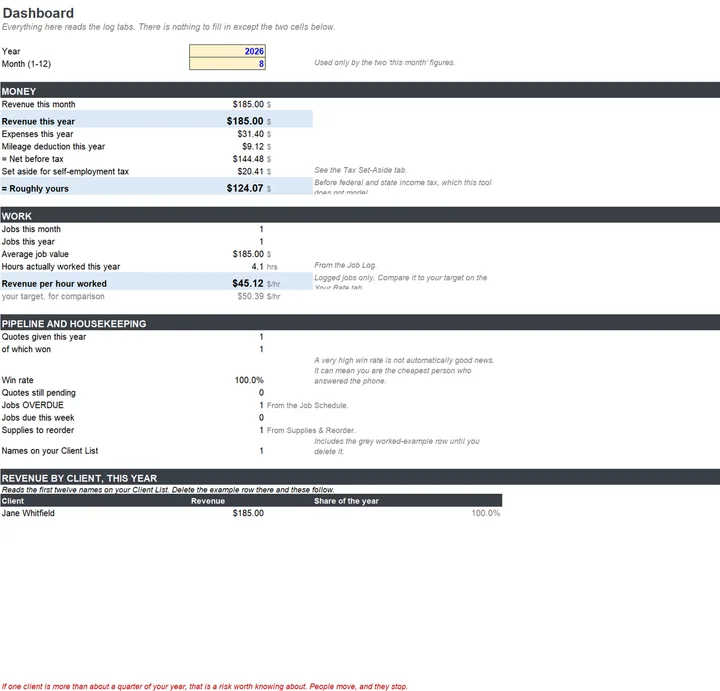
What you quoted, and what happened. Date, client, amount, outcome — won, lost, or still pending. Four fields. From them you get your win rate, and a win rate is the only honest read on whether your price is out of step with your market. Most people have no idea what theirs is.
How long jobs actually took, against what you estimated. The gap between the two is the single most useful number in a service business. It tells you whether you are pricing your work or hoping about it, and it is usually concentrated in one type of job rather than spread evenly — which makes it fixable.
When you last served each client. Without it, clients drift away silently. You do not notice the one you have not visited in six weeks. You notice them when they call somebody else.
What each client actually paid over the year. This is where concentration risk becomes visible. One client at more than about a quarter of revenue is worth knowing about, and it is invisible from memory.
None of that appears on a tax return. All of it changes decisions.
The test worth using
Not "will I be audited." For most small operators that is unlikely, and building a system around an unlikely event produces a system you resent and abandon.
Use this instead: can I answer a real question in under a minute?
- What did I actually make last quarter, after everything?
- Who owes me money, and how late are they?
- Which client is the biggest share of my year?
- Is that job type still profitable?
If those take an afternoon of reconstruction, you will not ask them — and not asking them is what costs money, far more reliably than any audit.
The habit under all of it
Log it in the same motion as doing it. The invoice when you send it. The expense when you spend it. The miles before you pull away. The job time when you finish.
Every system that depends on a weekly catch-up fails the same way: it survives until a busy week, and then it never recovers — and the busy weeks are exactly the ones with the most to record.
Fifteen seconds at the moment beats an afternoon in April, and unlike the afternoon in April, it produces something you can use while it still matters.
None of this is tax advice, and retention periods in particular depend on your circumstances — worth one conversation with whoever prepares your return.