How to Keep Track of Clients Without Buying a CRM
Most CRM software is built for a sales team chasing deals. A service business with forty recurring clients has almost the opposite problem, and needs about six things - none of which require a subscription.

Somewhere around the thirtieth client, the system stops working.
The system was your phone's contacts, some notes in a text thread, and knowing. Knowing that the Hendersons are every other Tuesday, that the gate code at the Wallaces is 4471, that Mrs. Okafor likes a text before you arrive, and that you have not been to the Brennans since the end of July.
Knowing works fine for fifteen clients. At forty it starts dropping things, and it drops them silently. You do not notice the client you have not visited in six weeks. You notice them when they call somebody else.
The obvious move is to buy software. It is usually the wrong move, and not for the reason people think.
Most CRMs are built for a different problem
Customer relationship management software grew up around sales teams. Its whole shape assumes a pipeline: leads arrive, get qualified, move through stages, and either close or die. The software is good at that, because that is the problem it was designed for.
A service business with forty recurring clients has close to the opposite problem. Your clients are not moving through stages. They are sitting still, in a rhythm, and the thing you need to know is not where are they in the funnel but when am I next due, and have I slipped.
So you end up paying monthly for a tool where the core screen is irrelevant to you, and doing your actual scheduling in a notebook anyway. This is extremely common and it is not a failure of discipline. It is a mismatch.
What you actually need
Strip it back. Here is the whole list for a one-person or small-crew service business.
1. Who they are, and how to reach them. Name, phone, email, address. Obvious, but it needs to be somewhere that is not only your phone, because phones get lost and replaced.
2. How to get in. Gate codes, lockbox numbers, which door, where the water spigot is, the dog's name and whether the dog is a problem. This is the single most valuable field and almost nobody writes it down. It lives in your head, which means it does not exist if someone covers for you, and it does not exist if you have not been there in four months.
3. What you agreed. The frequency and the price. Not what you charge in general — what you agreed with this person, which is often slightly different and which you will not remember accurately in a year.
4. When you last went. One date. This is the keystone.
5. What is due, and what is overdue. Which should not be something you decide. It should fall out of item 3 and item 4.
6. What they have actually paid you. Over the year, by client.
That is six things. None of them require a subscription.
Make the schedule calculate itself
Item 5 is where the leverage is, and it is worth being precise about how it works.
If you know the frequency in days — weekly is 7, every two weeks is 14, every three weeks is 21, monthly is 28, quarterly is 91 — and you know the date you last did the job, then the next due date is arithmetic. So is the number of days until it. So is whether it is overdue.
That means you maintain exactly one field: update "last done" the day you finish. That single habit keeps the whole schedule honest. Everything downstream — next due, days until, the overdue flag, the count of jobs due this week — reads from it.
Note the word days, not the word frequency. "Every two weeks" is a phrase; 14 is a number the arithmetic can use. Keep the number as the thing that drives the calculation and the phrase as the thing you read. When a client is on something odd — every ten days, or the first and third Wednesday — you change the number and the schedule keeps working.
The two questions to ask every Monday
Once the above exists, your entire weekly admin is two questions:
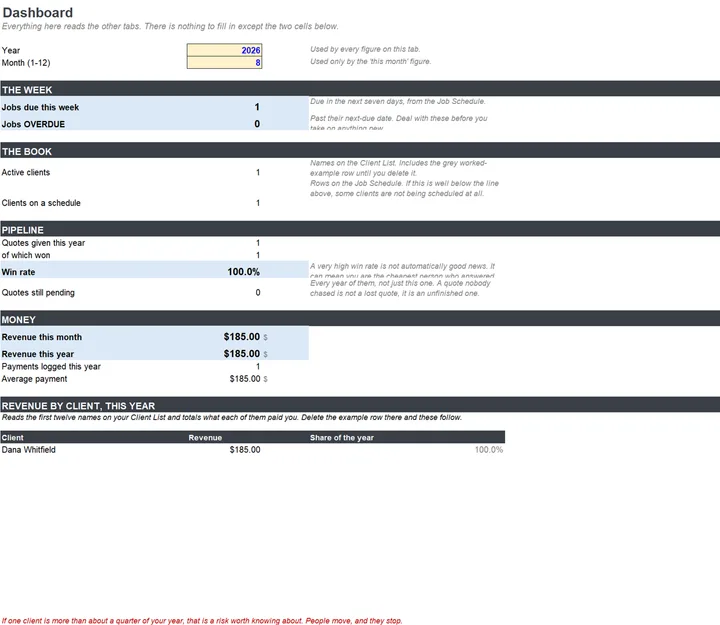
What is due in the next seven days? That is your week.
What is overdue? That is your problem list, and you deal with it before you take on anything new. An overdue recurring client is a client quietly deciding whether to replace you.
Everything else — quoting, invoicing, the rest — can wait until those two are answered.
Two things worth knowing that the notebook cannot tell you
Once the information is in one place rather than in your head, two numbers become available that are genuinely hard to see otherwise.
Clients on the book versus clients on a schedule. If you have forty names on the client list and thirty-one rows on the schedule, then nine people you consider clients are not booked for anything. Some of those are one-off jobs and fine. Some of them are people who think they are still your customer and are wondering why you have not been round.
Revenue concentration. Total the year by client and look at the top one. If a single client is more than about a quarter of your revenue, that is a risk worth naming out loud — not because they are going to stop paying, but because people move, budgets get cut, and businesses close. One client at 40% means your income is one phone call from halving. You cannot fix what you have not measured, and this one is invisible until you total it.
The honest limitation
None of this does anything you could not do with a well-kept notebook and a good memory. It is not clever. What it does is survive a bad month — a stretch where you are behind, working late, and running on what you can hold in your head. That is exactly when the notebook stops getting updated and clients start slipping through, and it is exactly when a system that calculates its own overdue list earns its keep.
The test of a system is not how well it works in a good week. It is what it still tells you after you have neglected it for one.