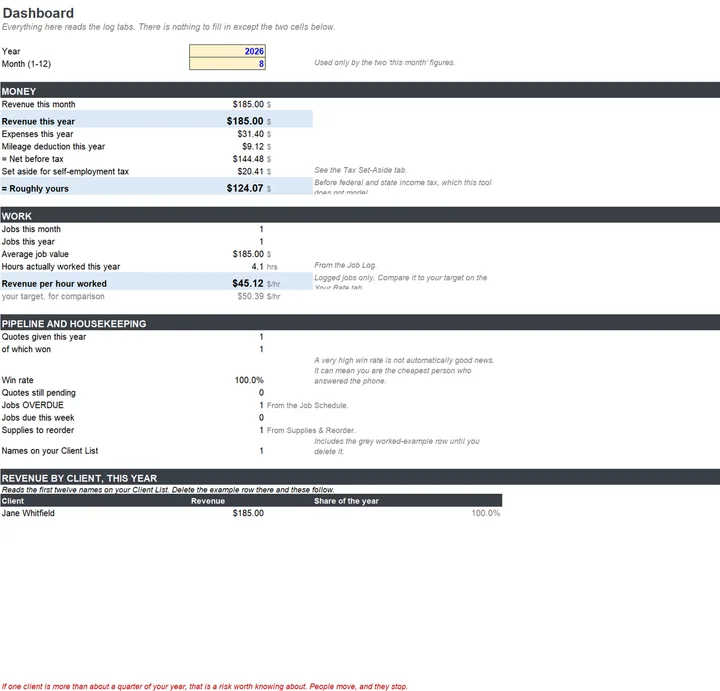
Revenue Is Not Profit, and the Gap Is Where Businesses Die
Four different numbers all get called "what I made this year", and on a normal small business they can sit forty thousand dollars apart. Most people are quoting the largest one and living on the smallest.

Ask somebody how their year went and they will tell you a number.
Almost always it is the biggest one available — what came in. It is the easiest to know, because it is the only one that appears without any work.
There are four numbers, and on an ordinary small service business they can sit tens of thousands of dollars apart. Being unclear about which is which is not an accounting nicety. It is how people work six days a week for three years and end up with nothing.
The four numbers
Revenue. Everything customers paid you. $90,000.
Gross profit. Revenue minus the direct costs of doing the work — materials, supplies, subcontractors, fuel attributable to jobs. Say $22,000 of those. Gross profit: $68,000.
Net profit. Gross profit minus overhead — insurance, vehicle, phone, software, licenses, advertising, accounting, equipment replacement. Say $12,000. Net profit: $56,000.
What you actually keep. Net profit minus tax. Self-employment tax alone is roughly 14.13% of net profit — about $7,900 — before any income tax at all. Call income tax another $6,000 depending entirely on your situation. What you keep: around $42,000.
Ninety thousand at the top. Forty-two at the bottom. Both are true, and only one pays your mortgage.
Why the confusion is expensive
It corrupts pricing. "I made $90,000 on 400 jobs, so I'm getting $225 a job" is a sentence that leads directly to underpricing, because the real figure is closer to $105 and the costs do not go away when you cut the price.
It makes growth look like progress. Revenue up 20% with margins down is a business doing more work for less money. That is extremely common and nearly invisible if revenue is the only number you watch. You feel busier and assume you are doing better.
It hides the real problem. Two businesses at $90,000 revenue with $42,000 and $18,000 kept are not similar businesses. Revenue cannot tell them apart, and neither can your bank balance in a good month.
It makes April a shock. If you have been treating deposits as income, the tax bill arrives against money you have already spent.
The number to actually run on
Net profit, watched monthly, is the one that governs decisions.
Not because the others are useless — gross profit tells you whether your pricing covers the work, and revenue tells you about demand — but because net profit is the only one that answers "is this worth doing."
And know it as a percentage, not just a dollar figure. Net profit divided by revenue is your margin, and margin is what lets you compare a good year to a bad one when the volume was different. A business that did $90,000 at 62% and $130,000 at 41% did better in the smaller year on every measure that matters except bragging.
Watch the margin over time. A margin that drifts down while revenue climbs means costs are growing faster than the work — usually a route getting looser, prices that have not moved, or scope that has quietly grown.
Two mistakes that make the numbers lie
Not paying yourself a defined amount. If you take money out whenever the account looks healthy, your business has no labor cost and its profit is fiction. On paper it looks wildly profitable; in reality it is subsidized by unpaid work.
Pay yourself a set amount on a schedule. Then net profit is the profit after your wage, which is the only version that tells you whether the business earns anything beyond employing you. Plenty of small businesses turn out to be jobs with extra risk. That is fine — but you should know.
Ignoring equipment replacement. The mower, the vacuum, the truck. They wear out on a schedule and get replaced in a lump, and a year with no replacement looks more profitable than it is. Set aside a monthly amount so the cost lands where it was earned.
Knowing it in November instead of April
The whole thing rests on one habit: log income and expenses as they happen, in one place, in the same motion as the transaction.
Then at any point you can answer three questions in under a minute:
- What have I earned so far?
- What have I spent, and on what?
- What is the profit, and what is the margin?
If those take an afternoon of receipt archaeology, you will not ask them, and you will find out in April when nothing can be changed. If they fall out of a log you already keep, you ask monthly without effort — and a bad margin found in November is a problem you can still fix.
The sentence worth keeping
Revenue is what the market thinks of your marketing. Profit is what the market thinks of your business.
You can raise the first by cutting prices. Only the second pays you.