Pricing Your First Commercial Cleaning Contract
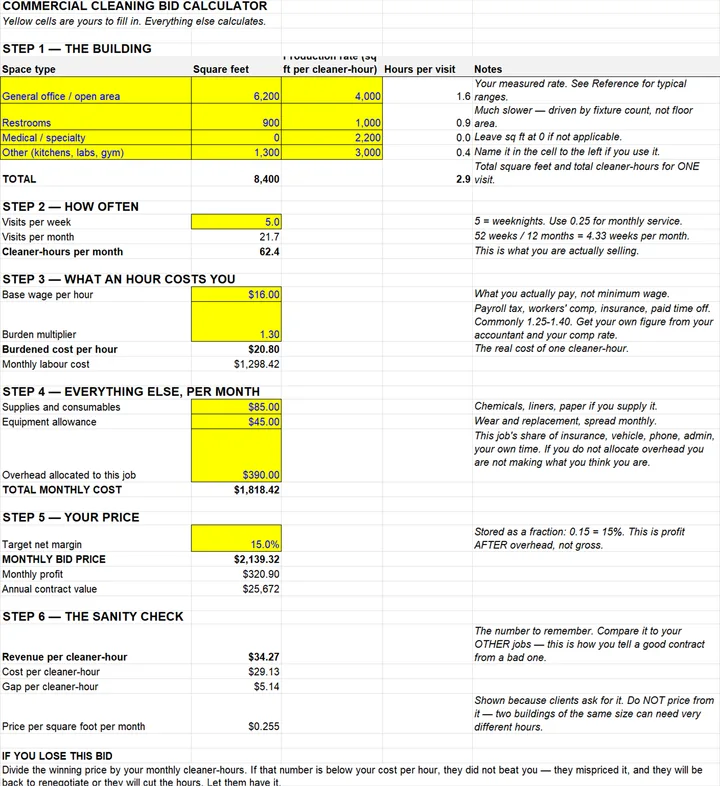
A commercial cleaning bid is one number with four inputs behind it. Get the production rate wrong and everything downstream is wrong, which is why the published rates are a starting point and not an answer.
The first time somebody hands you a walkthrough and asks for a monthly number, the temptation is to guess low. You want the contract. You have no idea how long the building takes. Low feels safe.
Low is not safe. A residential job priced wrong costs you an afternoon. A commercial contract priced wrong costs you every month for a year, and you cannot easily fix it, because you signed something.
The good news is that a commercial bid is more mechanical than a residential quote. Buildings are measurable. The arithmetic is short.
The four numbers
Every commercial cleaning bid is built from the same four inputs:
1. Cleanable square footage. Not the gross area of the building — the area you actually service. Deduct what you are not cleaning.
2. Production rate. How many square feet of this kind of space one cleaner covers in an hour.
3. Frequency. How many times a month you are there.
4. Your hourly cost. What an hour of labor costs you, all in.
Square footage divided by production rate gives hours per visit. Hours per visit times frequency gives hours per month. Hours per month times your loaded hourly cost gives your monthly cost. Add overhead recovery and margin, and that is your bid.
That is the whole model. Everything difficult about it lives in number two.
Production rates are the number that decides everything
A production rate is square feet per cleaner-hour. Open office space with hard floors cleans fast. A restroom-heavy floor plan cleans slowly. A medical facility with detailed disinfection protocols cleans slower still. The same 10,000 square feet can be three hours or seven depending on what is in it.
Published production rate tables exist. Use them to start — and understand exactly what they are.
They are averages, drawn from crews that are not yours, in buildings that are not this one, using equipment you may not have. They do not know that this building's restrooms are on three separate floors, that the elevator is slow, or that the trash room is across the parking lot. They do not know how fast you work.
So the honest way to use a published rate is as a first bid input and a hypothesis, not an answer. Any bidding tool worth having should tell you which of its figures are estimates rather than presenting everything with the same confidence — and should give you somewhere to put your own measured times once you have them.
Measure two buildings and stop guessing
The fix is small and nobody does it: time yourself.
On your first two or three contracts, record the actual clock time and the actual square footage. Not your estimate. What happened. Two data points from buildings you have really cleaned are worth more than any table, because they include your equipment, your pace, and your standards.
After that you are not bidding from an industry average. You are bidding from your own history, and your bids get tighter and more competitive at the same time, because you stop padding to cover uncertainty you no longer have.
This is the single largest source of error in a first-year cleaning business, and it is the one you can eliminate in about a month of paying attention.
Turning hours into a price
Your hourly cost is not the wage. If you are paying someone $18 an hour, that hour costs you meaningfully more once you add payroll taxes, workers' compensation, supplies, and equipment wear. If you are doing the work yourself, the number still is not zero — it is what your time has to earn.
Then there is overhead: insurance, vehicle, phone, licensing, admin time. That has to be recovered across the contracts you actually hold, not across the ones you hope to hold. New operators routinely spread overhead across an imaginary book of business and end up under-recovering all year.
Take twelve months of overhead, divide by the billable hours you can realistically service in a year, and add that to the hourly cost. Now every hour you bid carries its share.
What to exclude, in writing
The bids that go wrong are rarely wrong about the floor. They are wrong about the things nobody discussed.
Say what is not included. Strip and wax. Carpet extraction. Window exteriors. Construction cleanup. Pressure washing. Supplies — are you providing paper products and liners, or are they? That last one alone can be a few hundred dollars a month, and it is the most common thing to be assumed in opposite directions by the two parties.
Say what happens when the scope changes, and put a number on it. "Additional services quoted separately" is a sentence that prevents an argument.
The thing that will actually decide whether you keep the contract
Price gets you the contract. Keys, codes, and access keep it.
Commercial cleaning is done in an empty building, at night, when nobody is there to answer questions. Every access detail matters: which door, which code, which key, what the alarm sequence is, and who to call at eleven at night when the code has been changed and nobody told you. Get one of those wrong and you have a crew standing in a parking lot being paid to do nothing.
Write it down before the first shift, and write down who is responsible for each item. It is not a glamorous part of the business and it is the part that goes wrong first.
And a word on the number you will be tempted to use
At some point somebody will tell you the going rate is a certain number of cents per square foot, and it will be tempting to just use that.
Published per-square-foot bands contradict each other by wide margins, and correct bids from a proper cost model land on both sides of most of them. A per-square-foot figure is useful for one thing only: a sanity check at the end, to see whether your bid is in a completely different universe from the market. It is not a way to build a price, and it will not tell you whether you can afford to do the work.
Build from hours. Check against the market. Not the other way round.