You're Booked Solid and Still Broke
A full schedule and an empty bank account is not bad luck and it is not a mystery. It is one of four things, and you can find out which in an afternoon.

You are working six days. The phone rings. You turn people away. By every visible measure the business is doing well.
And there is no money.
This is the most demoralizing position in self-employment, because every instinct you have — work harder, take another job, get up earlier — makes it worse. You are already at capacity. More effort has nowhere to go.
It is also not a mystery. It is one of four things, and an afternoon with your own numbers will tell you which.
1. The price is wrong
The most common by a wide margin, and the hardest to see, because a wrong price feels exactly like a right price until you total the year.
The tell is your win rate. If you are winning nearly every job you quote, you are the cheapest person who answered the phone. That fills a schedule quickly and it fills it with work that does not pay.
Run one job all the way down. Take a typical job at your typical price and subtract everything: materials, fuel, the wear on the equipment, your share of insurance and overhead, and the self-employment tax on what is left. Then divide by the real time the job took, drive included.
Most people doing this for the first time find a number that shocks them. Not because they are bad at the work — because the price was set in a nervous first year and has not moved since.
2. The time is wrong
The price might be fine. The job might just take longer than you think it does.
This is the quiet one. A job quoted at two hours that reliably takes two hours forty is running at 74% of the rate you believe you are charging, and nothing about your day feels unusual. You are not slow. You are estimating from a number that stopped being true.
The only fix is measurement. Log estimated against actual for twenty jobs. The gap is your answer, and it is usually concentrated in one type of job rather than spread evenly — which makes it fixable.
3. The route is wrong
You are being paid for the work and not for the driving, and the driving has grown.
Two numbers, very far apart:
- Revenue per billable hour — the price divided by hours on the property.
- Take-home per windshield hour — what is left after costs, divided by the time from leaving one stop to leaving the next.
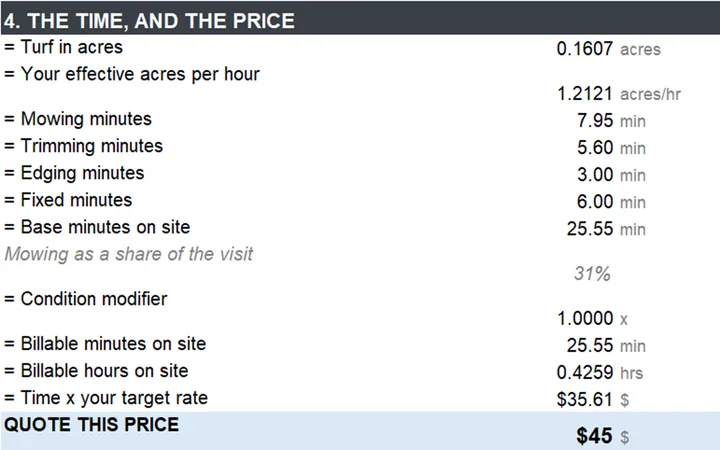
On a real residential route these sit a factor of two apart. A worked example: a $45 stop returns $105.66 per billable hour and $50.62 per windshield hour. Same job, same money. The gap is 52%.
You quote in the first number. You live in the second. And the second gets worse every time you accept a job across town, because new clients arrive from wherever they arrive from and nobody notices a minute.
Change only the drive between stops and a field day moves from about $450 of take-home to about $292. That is a third of your income decided by scheduling, with no change to the work at all.
4. The money was never yours
This one is not about the business. It is about which account the money is in.
Self-employment tax runs to roughly 14.13% of net profit and nobody withholds it. If you have been spending from a balance that includes the tax you owe, the business may be perfectly healthy and you are simply living on money that has to be given back.
The symptom is specific: things feel fine month to month and catastrophic once a year. If that is the shape of your problem, you do not have a pricing problem. You have a set-aside problem, and it is the easiest of the four to fix.
How to tell which one you have in an afternoon
Four questions, in this order.
What did I actually make last year, after everything? Not revenue. Revenue minus every cost, minus tax. If that number is respectable and your account is empty, it is problem four.
What is my win rate? If it is near 100%, start with problem one.
What is the gap between quoted and actual time? If it is more than about 15%, that is problem two, and it is inflating problem one.
How many hours a week am I driving? Total it honestly for one week. If it is more than about a fifth of your working time, that is problem three.
Most people find two of the four. They compound: an underpriced job that takes longer than quoted, on a scattered route, is losing money three separate ways at once, and each one alone would have been survivable.
What not to do
Do not take on more work. You are full. Adding work at a losing price loses more.
Do not hire. Hiring somebody to do underpriced work faster multiplies the mistake and adds payroll to it. Fix the price first — and notice that fixing the price is often what makes a hire viable later.
Do not cut your own pay further. It is already the shock absorber. That is why the account is empty.
The one that actually helps
Raise the price, and let some clients go.
Forty clients at $45 is $1,800. Thirty-seven at $52 is $1,924. More money, three fewer stops, three fewer drives, and a slot back.
The clients who leave over a modest increase are almost always the scattered, price-sensitive, high-maintenance ones — the exact work that was making the arithmetic bad. Losing them is not a cost of the fix. It is most of the fix.
Being busy is not the same as doing well, and the busiest person in a trade is frequently not the best paid. That is not bad luck. It is a price that was set once, three years ago, by somebody with no idea what the work cost.