What Your Truck Actually Costs You Per Mile
Most people price their driving at the cost of gas. Gas is usually under a third of what a mile actually costs, and the rest arrives all at once, eighteen months later, as a repair bill.

Ask somebody what their truck costs to run and they will tell you what they spend on fuel.
Fuel is the visible part. It is also, for most work vehicles, well under a third of the real cost per mile. The rest is invisible because it arrives in lumps — a set of tires, a transmission, an insurance renewal — long after the miles that caused it.
This matters twice. It matters for tax, because the deduction is one of the largest available to a route business. And it matters for pricing, because a job forty minutes away is consuming something real that most quotes ignore.
The costs, in rough order of size
Depreciation. Almost always the largest, and completely invisible. The truck is worth less at the end of the year than at the start, and the miles are much of the reason. You do not write a check for it, so it never feels like a cost — right up until you need to replace the vehicle and discover what it is worth.
Fuel. The obvious one. Simple to track, and the only one most people do.
Tires. A set every 40,000 to 60,000 miles, sooner on a loaded truck or one towing a trailer. Divide the set by the miles and it is a real per-mile number.
Maintenance and repair. Oil, brakes, belts, and the things that go wrong. Work trucks carrying weight and idling a lot age faster than the mileage suggests.
Insurance. Commercial auto is not cheap, and if you are hauling a trailer or equipment your rate reflects it.
Registration, inspection, licensing. Small annually, real over the life.
The trailer, if you tow one — its tires, its bearings, its lights, its registration.
Add all of it, divide by the miles you drove, and you have a cost per mile. Do it once a year.
Most small operators are surprised by the number. It is routinely two to three times what they had been carrying in their head, which was the fuel figure.
Why this changes how you price
Once you know your real per-mile cost, the arithmetic on a distant job stops being a feeling.
A stop that is twenty-five minutes each way is perhaps twenty-five extra miles round trip. At a real cost per mile, that is a specific number of dollars gone before you have picked up a tool — on top of the fifty minutes of unbillable driving, which is usually the larger loss.
This is the number that makes route decisions concrete. Route density is worth more than most people think, and the vehicle cost is the part that can actually be measured rather than argued about.
It also gives you a defensible travel surcharge. "There's a $15 travel charge outside my usual area" is easier to say, and easier to hear, when you know exactly where the fifteen came from.
The tax side, and why the two are different numbers
For tax, you generally choose one of two methods, and this is worth being clear about because people confuse the tax number with the true cost.
The standard mileage rate. Multiply business miles by a per-mile rate the IRS publishes annually. It is designed to cover everything — fuel, maintenance, tires, insurance, depreciation — so you do not deduct those separately. Simple, and usually the better choice for a single-vehicle operation.
Actual expenses. Track every real cost and deduct the business-use percentage.
Whichever you choose, the deduction is not the same thing as your operating cost. The standard rate is a national average built for tax administration. Your actual cost per mile is a fact about your truck, your route, and how hard you use it. One belongs on your return; the other belongs in your pricing. Do not let the tax figure stand in for the business figure.
There are also rules about switching between methods once you have started with one, and rules that differ for a leased vehicle. That is exactly the sort of thing to settle once with whoever prepares your return rather than infer.
What you need to record
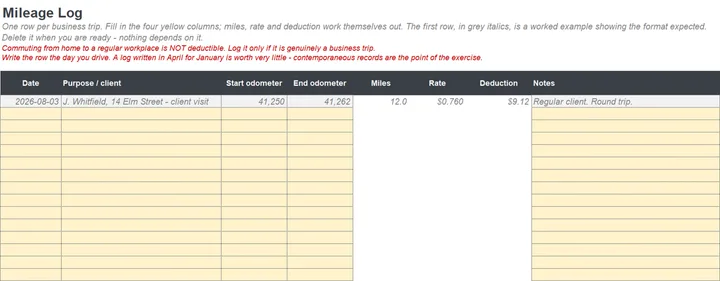
Less than people fear. For both purposes, the same log does the work:
- Date
- Odometer out and back — or the miles, if your vehicle gives them to you
- Where and why — enough words to identify the trip
That is it for the tax side. For the cost side, keep the receipts for fuel, tires, service and insurance in one place so the annual total is an addition rather than an investigation.
Write the trip down in the truck before you pull away. Fifteen seconds. Every system that relies on catching up at the weekend fails in the first busy week and never recovers, and the miles you lose are the short hops between jobs — which on a route business are the majority.
The one people get wrong
The second job of the day.
People remember the drive out and the drive home and forget the six legs in between. On a route business those legs are most of the mileage. Home to client A, A to B, B to C, C to home — if your home is your principal place of business, all of it is business mileage, and the middle is the biggest part.
Missing them does not just cost you the deduction. It makes your route look cheaper than it is, which quietly encourages exactly the scattered scheduling that is costing you the most.
The short version
Total everything the vehicle costs for a year. Divide by the miles. That number belongs in your pricing.
Keep a contemporaneous log of business miles. That log serves your return.
They are two different numbers from the same habit, and the habit is fifteen seconds a trip.