Should You Charge Late Fees?
A late fee you do not enforce is worse than no late fee at all - it is a written statement that your terms are decoration. Most people write one and never charge it.

Almost every invoice template has a late fee line, and almost nobody ever charges one.
That is the real problem, and it is worse than not having the clause at all. An unenforced late fee is a written statement, on your own paperwork, that your terms do not mean anything. Customers who pay slowly learn that faster than you do.
So the question is not whether to put a line on the invoice. It is whether you will actually use it.
What a late fee is for
Not revenue. If you are relying on late fees for income, something has gone badly wrong elsewhere.
A late fee exists to change where you sit in somebody's payment queue.
This is the part worth understanding. A commercial client with limited cash this week is not deciding whether to pay you. They are deciding whom to pay first. Suppliers who charge interest and suppliers who do not are treated differently, because one costs money to delay and one does not.
You want to be the invoice that costs something to postpone.
Where it works, and where it does not
Works on commercial clients. An accounts-payable department is a process, and processes respond to rules. A fee applied consistently moves your invoice up the queue with no conversation and no bad feeling — it is not personal to anybody there.
Works on repeat clients with a pattern. Somebody who is habitually three weeks late is not in crisis; they have simply learned that nothing happens. A fee, announced in advance and then applied once, usually fixes it permanently.
Does not work on genuine hardship. Somebody who cannot pay will not be helped into paying by a surcharge. You are adding a number to a debt that is already stuck, and you will collect neither. A payment plan is the tool for this, not a penalty.
Does not work as a first move on residential clients. Households are not queues. A fee on a $180 house-cleaning invoice that is nine days late reads as petty and costs you the relationship. Chase it with a phone call instead.
How to set one that is defensible
Say it before the work, not after. A fee that first appears on the overdue notice is a new term invented under pressure. It belongs in the quote and on every invoice from the first one.
Keep it modest and explainable. 1% to 1.5% a month is the common range and reads as standard commercial practice. A flat fee — $25 after 30 days — is simpler and often better for small residential work.
Check your state. Some states cap what you can charge on overdue commercial accounts, and consumer transactions can be governed differently from business-to-business ones. This is worth ten minutes of looking up or one question to an accountant, because a fee that exceeds a legal limit is not just unenforceable, it can create a problem where you had none.
Give a grace period. Five to ten days. Payments genuinely get delayed by mail, by banking, by a person being out. A fee that triggers the morning after the due date will fire on people who did nothing wrong, and you will end up waiving it, which teaches the wrong lesson.
Warn once, then apply it
The sequence that actually works:
1. The terms and the fee are on the quote and on the invoice.
2. It goes past due. Friendly note, no fee mentioned.
3. Grace period ends. One warning, with a date: "A late fee of $25 applies from the 15th."
4. That date arrives. Apply it. Send the revised invoice.
Step four is where everyone fails. Applying it once, to one client, is what makes the clause real for all the others — because the alternative is that your paperwork says one thing and your behavior says another, and people calibrate to behavior.
If you are not going to do step four, remove the clause. Honest terms with no fee beat a bluff.
The lever that works better
For repeat and recurring clients, there is a stronger tool than money: schedule.
No new work is booked until the balance clears.
This costs you nothing, requires no legal check, and lands harder than a percentage — especially with a client who wants their regular slot. It is also cleaner to say, because it is a fact about your capacity rather than a punishment.
For a fortnightly client three weeks behind, "I'll get you back on the schedule as soon as the outstanding one clears" resolves things faster than any surcharge, and does it without either of you having a fight about it.
What has to exist first
None of this works from memory. To apply a late fee you have to know, without hunting, which invoices are past due and by how many days.
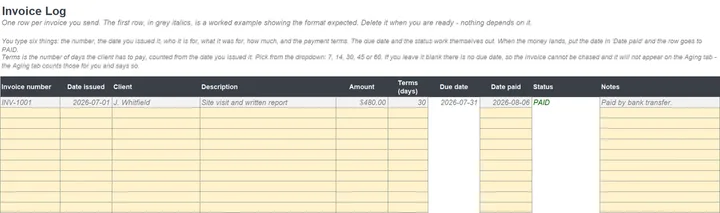
That means logging invoices when you send them — number, date, client, amount, terms — so that overdue status calculates itself rather than depending on you noticing. If working out who is late takes forty minutes, you will do it quarterly in a panic, and a fee applied at random three months later is not a policy. It is a surprise, and surprises damage relationships without changing behavior.
The clause is the easy part. The list is the part that makes it true.
The short answer
Have a late fee if you have commercial clients or repeat clients with a pattern, state it up front, keep it modest, check your state's limits, and be willing to apply it at least once.
If you will not apply it, do not print it. Terms nobody enforces are worse than terms nobody wrote.