Residential or Commercial Cleaning — Which Should You Start With?
These are not two versions of the same business. They differ on when you work, how you sell, how fast you get paid and what happens when you lose a client - and the right answer depends mostly on your circumstances, not your preference.
They share a word and almost nothing else.
The work looks similar from outside — you clean a space to a standard for money — but as businesses they differ on nearly every axis that matters: when you work, how you sell, how long you wait to be paid, what you need to own, and what happens when a client leaves.
Picking the wrong one for your circumstances is the most expensive mistake available at the start, and it is entirely avoidable.
When you work
Residential is daytime. Clients want you there while they are out, roughly nine to four. That is a fixed constraint and it collides directly with a day job.
Commercial is evenings and nights, after the building empties. That makes it close to ideal if you are starting while employed — you can service real contracts without giving up a salary.
For a lot of people this single line settles it.
How you sell
Residential is a short cycle. Somebody wants their house cleaned, you quote, they say yes or no, often within days. Referral-driven, emotionally-driven, and fast.
Commercial is a long cycle. Buildings are already under contract, usually annually. You are not selling to somebody with a need — you are getting on a list and waiting for a renewal or a failure. Three to six months from first conversation to first shift is normal.
That has a hard implication: commercial takes longer to produce any income at all. You need runway to survive the sales cycle, whereas residential can produce revenue in a fortnight.
Cash flow, which is where businesses actually die
Residential pays fast. Often on the day, increasingly by card at completion. Small amounts arriving frequently.
Commercial pays on terms. Net 30 from invoice acceptance, on a payment run, through an accounts payable department that has never met you. Thirty to forty-five days after the first month of service is normal — which can be sixty to seventy-five days from your first shift to your first payment.
Meanwhile you are buying supplies and possibly paying somebody throughout. This is the classic way a new cleaning business dies holding a good contract: not lack of work, lack of cash in the gap.
If you have thin savings, residential's fast cycle is not a preference. It is a requirement.
What you need to own
Residential starts genuinely cheap. A good vacuum, a caddy of supplies, cloths, insurance. A few hundred dollars is a real start.
Commercial wants commercial equipment — backpack vacuums, sometimes a floor machine or auto-scrubber, transport to carry it, higher insurance limits, often bonding for after-hours building access.
The important rule either way: let the contract specify the equipment. Bid the building, win the building, then buy what it needs. Equipment bought speculatively depreciates while it waits for a contract you have not won.
Revenue shape, and the risk that comes with it
Residential: many small clients. Losing one is a bad week. Prices are per-visit and easy to move at an annual review. Your risk is spread thin.
Commercial: few large contracts. One building can be a third of your revenue, which is a comfortable place to be right up until a renewal goes the other way. Prices are locked for a contract term, so a bad bid is a bad year rather than a bad month.
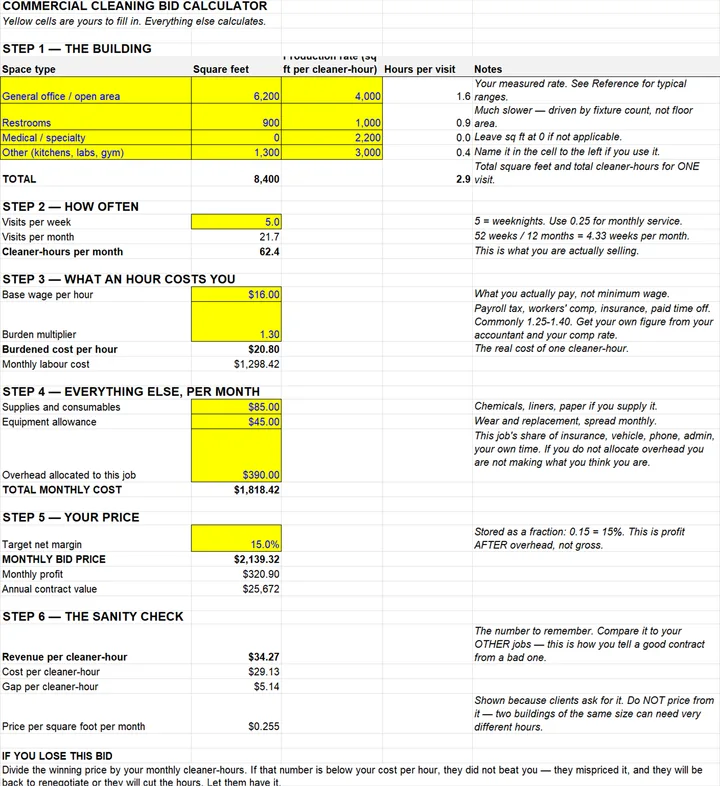
That concentration is the defining risk of commercial, and it is why the bid has to be right. In residential you can correct a pricing mistake in three months. In commercial you have signed it.
Where the money is
Commercial contracts are larger and steadier, and the ceiling is higher — you can service several buildings with a crew in a way you cannot easily replicate house to house.
But per hour, well-run residential is frequently better, especially solo. Residential rates per hour are typically higher, the work is closer together if you route it properly, and there is no bidding process to lose.
The honest version: commercial scales better, residential pays better per hour early on.
The decision, as it actually falls out
Start residential if: you need income within weeks, savings are thin, you have daytime availability, and you want to learn pricing quickly against many small decisions rather than one large one.
Start commercial if: you have a job you are keeping for now, you have three to six months of runway, you can work evenings, and you would rather manage four relationships than forty.
Do not try to do both at once at the start. They need different equipment, different insurance, different sales approaches and different hours. Splitting your attention across two businesses is why people spend a year at half speed in each.
Whichever you pick, do this
Time your first few jobs honestly — real clock time against real square footage or real room count. Two measurements from work you actually did beat every published production-rate table, because they carry your pace, your equipment and your standard.
That is the same advice in both businesses, and in both it is the single largest source of error in the first year. It is also the one you can eliminate in about a month of paying attention.