Quarterly Estimated Taxes, and How They Actually Work
The quarters are not quarters, the deadlines are not evenly spaced, and the penalty is for paying late rather than for paying too little. Worth understanding once.

The phrase makes it sound simple: four payments, one every three months. It is not quite that, and the details are the part that trips people.
Understanding the shape of it once removes most of the anxiety, because the anxiety is almost entirely about not knowing how it works rather than about the money.
Why it exists
Employees have tax withheld from every paycheck. The government gets paid throughout the year rather than in one lump the following April.
Self-employment removes that machinery. So the system asks you to do the same thing manually — pay as you earn, four times a year, rather than settling everything at once.
You are not paying extra. You are paying earlier, on the same total.
Who owes them
Broadly, if you expect to owe a meaningful amount when you file — the threshold is modest and set by the IRS — you are generally expected to pay estimated tax through the year.
There are situations that change this. If your spouse has a job with withholding, that withholding counts toward the household's liability and may cover enough of it. If you had no tax liability at all last year, there are provisions that can apply.
Whether you owe them, and how much, is a fifteen-minute conversation with whoever prepares your return, and it is worth having once rather than guessing annually.
The quarters are not quarters
This is the detail that catches everybody. The payment periods are not three months each, and the deadlines are not evenly spaced.
The first period covers the start of the year and is due in the spring. The second period is two months long. The third covers the late summer. The fourth runs to the end of the year and is due in the following January.
So there is a bunched stretch in the middle of the year and then a long gap. If you budget as though it were "every three months," you will be short for one of them.
Get the actual dates for the current year from the IRS and put them in a calendar with a reminder a week ahead. Deadlines shift when they land on a weekend or holiday.
What you are paying
Two things combined:
Self-employment tax — Social Security and Medicare, both halves, because you are both employer and employee. Roughly 14.13% of net profit once the deductible-half adjustment is accounted for.
Income tax — federal, and state if your state has one. Depends on your bracket, filing status, deductions, and the qualified business income deduction.
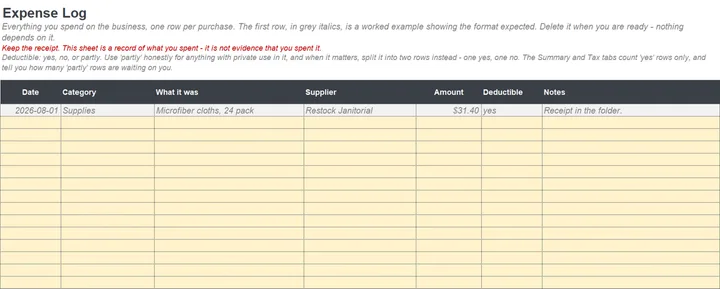
Both are calculated on profit, not revenue. Revenue minus legitimate business expenses. Which is the entire reason expense tracking matters: every deductible dollar you fail to record is a dollar you pay both taxes on unnecessarily.
Safe harbor is the useful idea
The part worth understanding, because it removes the need to predict your year accurately.
There are provisions that protect you from an underpayment penalty if you have paid at least a certain amount over the year — commonly framed as a percentage of last year's total tax, with a higher percentage for higher earners, or a percentage of this year's actual liability.
The practical value is this: you do not have to forecast a volatile year correctly. If you pay based on what you owed last year, you are generally protected from the penalty even if this year turns out much bigger — you just settle the difference in April.
That is a significant relief for a business with a lumpy income, and plenty of people have never heard of it. Ask your preparer which safe harbor applies to you and what the quarterly number is. Then it becomes a fixed, known amount four times a year rather than an anxious calculation each time.
The penalty is for timing, not for underpaying
Worth being precise about, because it changes behavior.
The underpayment penalty is essentially interest on money that should have been paid earlier in the year. It is not a fine for getting your estimate wrong.
Two consequences. First, missing a quarter and catching up later costs you interest for that period rather than a punishment. Second — and this is the one people get wrong — paying the whole year's estimate in the fourth quarter does not fix a missed first quarter. The system looks at when the income was earned against when it was paid.
Making it routine
The mechanics are the easy part. The habit underneath is what decides whether this is stressful.
Move the money the day it arrives. A fixed percentage of every payment, straight into a separate account, the day it lands. Not at month end. Not when you remember. The day it arrives.
This works because you are not fighting temptation — you are removing the money from view. A balance you cannot see is a balance you do not mentally spend.
Then a quarterly payment is a transfer between two accounts you already had. People who find quarterlies painful are almost always people who were not setting aside. For anyone doing it, the deadline is administrative.
Know your profit as you go. You should be able to answer, in under a minute, what you have earned and spent so far this year. If that takes an afternoon of receipt archaeology, you will not check, and each deadline arrives as a surprise.
What to actually do
Have one conversation with a preparer covering: whether you owe estimates, which safe harbor applies, what your quarterly figure is, and what percentage you should be setting aside.
Put the four dates in a calendar with a week's warning.
Then move the money on the day each payment arrives, and stop thinking about it.
None of this is tax advice, and the thresholds, rates and safe-harbor percentages change and depend on your circumstances. The point is to know which questions to ask, and to have the money there when the answer arrives.