The Mileage Deduction Most Self-Employed People Underclaim
Almost nobody keeps a mileage log during the year. They reconstruct one in April from memory and a calendar, and they underclaim - because a reconstruction is always conservative and always incomplete.

There is a particular kind of April afternoon where you sit down with a calendar, a bank statement, and a vague sense of dread, and try to remember where you drove eight months ago.
You will get it wrong. Not wrong in a way that gets you in trouble — wrong in the direction that costs you money. Reconstructions are always conservative, because you only count the trips you can prove to yourself, and you have forgotten most of them.
This is one of the few places in a small business where the fix is genuinely simple and the payoff is genuinely large.
What the deduction actually is
If you use your vehicle for business, you can deduct the cost. There are two methods, and you pick one:
The standard mileage rate. You multiply your business miles by a per-mile rate that the IRS publishes each year. That rate is meant to cover everything — gas, oil, tires, repairs, insurance, registration, and depreciation. You do not deduct those separately.
Actual expenses. You track every real cost of running the vehicle and deduct the business-use percentage of it.
For most single-vehicle service businesses, the standard rate wins on effort and often on amount. It requires one number per trip instead of a shoebox of receipts. The rate changes annually, so whatever tool or spreadsheet you use should carry the rate somewhere you can see it and change it, rather than baking a number into a formula where you will never find it again.
What counts
This is where the money is, and where most people are too cautious.
Counts:
- Driving between job sites in the same day
- Driving from your home office to a client, if your home is your principal place of business
- Trips to the supply house, the bank, the post office, the accountant
- Driving to meet a prospect, whether or not you win the job
- Driving to pick up or drop off equipment
Does not count:
- Commuting from home to a fixed regular workplace
- Personal errands, even in the work truck
- The personal leg of a trip you combined with business
The one that trips people up is the second job of the day. If you go home to client A and then to client B, the A-to-B leg is business mileage. People remember to count the drive out and the drive back and forget the six drives in between, which on a route business is the majority of the miles.
The arithmetic on a normal week
Take a service business with four stops a day, four days a week.
The drive out is eleven miles. The three hops between stops are four, six, and five miles. The drive home is nine. That is 35 miles a day.
If your home is your principal place of business, all of it counts. Four days a week, forty working weeks a year, is 5,600 miles.
At a rate somewhere in the region of what the IRS has published in recent years, that is a deduction in the low four figures. Against self-employment tax at roughly 14.13% of net profit, plus whatever your income tax bracket takes, the cash difference between claiming it and not claiming it is not small — and it is money you have already spent. You are not getting a benefit. You are being allowed to stop paying tax on money that was never profit.
Now consider what a reconstruction produces. You will remember the long drives. You will remember the unusual jobs. You will not remember the four-mile hop from the Hendersons to the Wallaces on a Tuesday in March, and there were roughly six hundred of those.
That gap is the entire argument for keeping the log as you go.
Why "contemporaneous" is the word that matters
The IRS wants records that are adequate and timely. In practice that means a log kept at or near the time of the trip, containing the date, the mileage, the destination, and the business purpose.
A log written in April from memory is not that. It may still be accepted, but it is on much weaker footing if anyone ever asks, and — more to the point — it is worse. Not because of the audit risk, which for most small operators is low, but because it undercounts.
The practical version of "contemporaneous" is not a burden. It is odometer out, odometer back, and a few words about why. If you write it in the truck before you pull away, it takes fifteen seconds. If you write it that evening, it takes a minute. If you write it in April, it takes an afternoon and costs you money.
Set up the habit so it survives a bad week
Every system for this fails the same way: it works for three weeks and then you have a busy Thursday and it never recovers.
Two things make it survive.
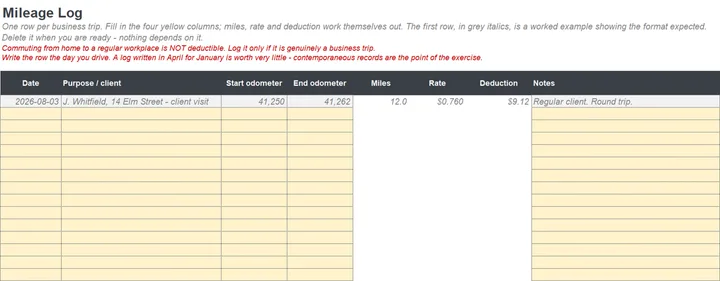
One place, always the same place. Not an app you have to remember to open, not a notebook that lives wherever you left it. One file, one row per trip.
Fill in only what you cannot calculate. You should be typing the date, where you went, why, and two odometer readings. The miles, the deduction, the running total, and the split by purpose should all work themselves out. Every field you have to compute by hand is a field you will skip when you are tired, and one skipped field turns into a skipped row, which turns into a skipped week.
And the part nobody withholds for you
While you are thinking about tax: the deduction reduces your net profit, and net profit is what self-employment tax is calculated on. That is roughly 14.13% before any income tax at all.
That is also the cost most commonly forgotten in pricing. If you are quoting jobs from a number that covers your costs and your wage but not the tax on the profit, you are quietly funding a bill that arrives later.
None of this is tax advice, and your circumstances may well differ — the rules on principal place of business in particular have real nuance. Talk to whoever prepares your return. But keep the log either way, because whatever the rules turn out to be in your case, you cannot claim what you did not write down.