Do You Need a Mileage App, or Will a Spreadsheet Do?
An app removes the need to remember. It does not remove the work — it moves it, from fifteen seconds in the truck to a review session you are equally likely to skip.

The pitch for a mileage app is good: it runs in the background, detects drives automatically, and you swipe each one as business or personal. No remembering, no odometer readings, no discipline required.
That is genuinely useful, and for some people it is clearly right. But it is worth being clear about what it does and does not solve, because the failure modes are not the ones people expect.
What an app actually solves
The forgetting problem. This is real and it is the biggest one. The trips people miss are the short hops between jobs, and they are missed because writing them down in the moment competes with everything else happening in the moment. An app captures them whether or not you were paying attention.
The reconstruction problem. You are never in April trying to remember March. The record exists, timestamped, at the time.
Legibility. A clean exportable log with dates, distances and locations is easy to hand to a preparer.
For somebody with a scattered route and forty short drives a week, that is worth real money in recovered deduction alone.
What it does not solve
Classification. The app knows you drove. It does not know why. Every trip still has to be marked business or personal, and if you do not do that within a few days you are back to reconstructing — from a list of addresses instead of from memory, which is better but not solved.
The work has moved. It has not disappeared. Fifteen seconds in the truck has become a five-minute review session, and a five-minute review session is exactly the sort of thing that gets skipped for three weeks.
Purpose. Adequate records generally want the business purpose, not just the distance. "14 Elm Street" is a destination. "Client — fortnightly clean" is a purpose. Most apps let you add a note; most people do not.
Battery and permissions. Automatic detection needs background location, which costs battery and can be interrupted by an OS update, a permission reset, or a phone that died at lunchtime. The gap is silent — you find it later.
Cost. Most are subscriptions. Modest, but it is a recurring cost against a problem a text file also solves.
Lock-in. Your records live in somebody else's service. Check you can export before you have three years in there.
What a spreadsheet solves
It is yours, permanently. One file, exportable, readable in twenty years, no subscription, no account to lose.
Purpose is a field you actually fill in. Because you are typing anyway, the note gets written at the moment you know what it was for.
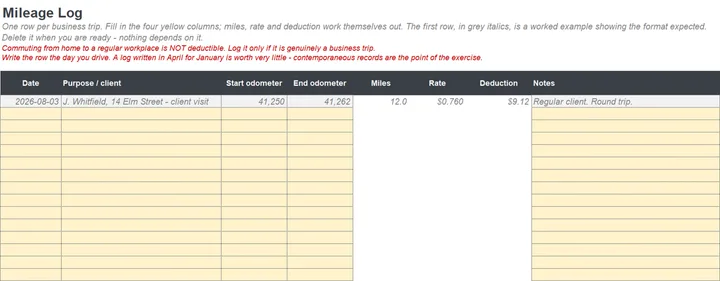
It computes what it should. Type the date, destination, purpose and two odometer readings. The miles, the deduction at the current rate, the running total and the split by purpose should all calculate themselves. Every field you compute by hand is a field you skip when tired.
It does the other job too. A log with your odometer readings is also what lets you work out your true cost per mile at the end of the year — which is a pricing number, not a tax number, and one an app will not give you.
It costs nothing.
What a spreadsheet does not solve
The remembering. All of it depends on you writing the trip down before you drive away. If that habit does not stick, the file is empty and the app would have won.
The honest decision
Take the app if: your route is dense with many short trips, you have tried a manual log and it has failed twice, and you will genuinely do the weekly classification review. The recovered deduction on the hops you were missing pays the subscription many times over.
Take the spreadsheet if: your trips are few and predictable, you want the record to be permanently yours, you want the cost-per-mile analysis as well, or you are already keeping a job log and adding two odometer fields to a habit you have is easier than building a new one.
Take both if you like, briefly — run the app for a month while keeping the manual log, and compare. The gap between them tells you what your manual log was missing, which is the only way to find out.
The thing that decides it, whichever you pick
Neither works without one habit attached to a real-world event.
Odometer out, odometer back, before you drive away. Or: open the app and classify the trip while still in the parking spot.
Anchor it to an event — arriving, leaving, finishing — not to a time of day or a day of the week. Systems tied to "Sunday evening" fail the first Sunday something else happens and never recover. Systems tied to "before I pull away" survive, because the trigger keeps arriving.
The tool matters far less than that. A perfect app with three weeks of unclassified drives is worth less than a plain text file somebody actually fills in.