How to Write an Invoice That Gets Paid Faster
Most late payment is not a customer refusing to pay. It is an invoice that was easy to set aside. A handful of details decide which kind of invoice yours is.

Before you chase anybody, look at the document you sent them.
A surprising share of late payment has nothing to do with willingness. The invoice arrived without a clear amount due, or without a date, or from an email address that looked like a newsletter, or it asked the customer to do something they could not do from their phone. It got set aside for later, and later is a place things go to die.
You cannot fix a customer who will not pay. You can fix an invoice that is easy to set aside.
Put a date on it, not a phrase
"Due on receipt" is the most common terms line on small-business invoices and one of the least effective. It is a phrase, not a deadline. There is no day on which it becomes true, which means there is no day on which it becomes late, which means there is no moment at which anyone — including you — is prompted to act.
Write an actual date. Due September 24.
Behind that date, pick a term and use it consistently: 7, 14, 30, 45. Thirty is the default in most commercial contexts. Shorter is entirely reasonable for residential work, where there is no accounts-payable department and no cycle to fit into.
And notice what a missing term does to your own records: an invoice with no due date cannot be late, so it never appears on an overdue list. It just sits there, quietly, not being chased. The invoices that go unpaid longest are almost always the ones that were never given a deadline.
The fields that remove friction
Every one of these exists to close a loop that would otherwise come back to you as a question — and a question is a delay.
An invoice number. Not for you. For them. It is how their bookkeeper files it, references it, and finds it when you ask about it later. Sequential is fine.
The issue date and the due date. Both. Explicitly.
What it was for, in their language. "Services rendered" is a line that gets queried. "Lawn maintenance, 14 Elm Street, August 4 and August 18" is a line that gets paid, because the person approving it can match it to something they remember agreeing to.
One clear total. The single number they are being asked to pay, visually obvious. If there is tax, show it, but make sure the amount due is unmistakable.
How to pay, specifically. Bank details, or a link, or "check payable to." The most common reason an invoice sits for a week is that paying it requires the customer to find out how.
Your contact details. So a question takes thirty seconds instead of becoming a reason to postpone.
Send it immediately
The gap between finishing the work and sending the invoice is the cheapest speed you will ever buy, and almost everybody gives it away.
The job is fresh. They are pleased with it. The value is obvious. Two weeks later the memory has faded, the work is just how the house looks now, and your invoice is one more thing in a pile.
Same-day is ideal. Within forty-eight hours is fine. "At the end of the month, when I do the invoices" is a habit that costs you two to three weeks of cash flow on every job, for no reason other than that batching feels tidier.
If batching is the only way it happens at all, batch weekly rather than monthly.
Make paying easy in the way that customer pays
This is worth more than any wording. Match the method to the client.
Commercial clients often need a purchase order number on the invoice or it cannot be processed at all — ask at the start of the relationship, not after the first invoice bounces back. Residential clients increasingly want to pay from a phone, which means a link beats bank details.
Card processing costs you a percentage. Slow payment costs you too, and unlike the processing fee, you cannot predict or price it. For a lot of small operators the fee is the cheaper of the two.
Then find out whether your terms mean anything
Once invoices are going out properly, one number tells you whether any of it is working.
Take every invoice you have actually been paid on and average the days between issuing it and the money arriving. Only the paid ones — an outstanding invoice has no payment date, and including it turns the average into a statement about the present rather than about your customers' behavior.
Compare that average to your stated terms.
If your invoices say 30 and the average is 47, your terms are decoration. That is worth knowing precisely because it is fixable. It usually means one of three things: the terms are not stated as a date, nothing happens when they pass, or a small number of persistently slow payers are dragging the average and you have not identified them.
Most people have never calculated this number, and when they do it comes in higher than they guessed.
What good looks like
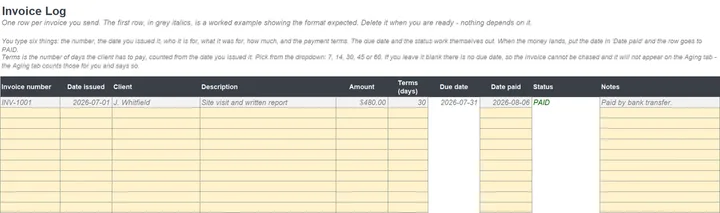
Invoice goes out the day the work is done. It carries a number, a date, a due date, a plain description, one obvious total, and an easy way to pay. It is logged when it is sent, so it appears on an overdue list by itself if nothing arrives.
At that point chasing stops being an emotional decision made at ten at night and becomes a five-minute Monday task with a list attached.
The wording of the follow-up matters far less than people think. Having a list at all is most of the job.