How to Read a Slow Month
A quiet month is three completely different problems wearing the same clothes, and the worst thing you can do is treat it as the one that frightens you most.

The phone is quieter than it was. Revenue is down. And because you are self-employed, the first explanation your brain reaches for is that it is over — the work has dried up, people have found somebody else, this was always going to happen.
That is almost never what is happening. But something is, and a quiet month is three completely different problems wearing the same clothes. Reacting to the wrong one costs real money.
The three, and how to tell them apart
Seasonality. The work always dips here and you have forgotten, because you have never plotted it. Lawn care collapses at both ends of the season. Residential cleaning goes quiet mid-summer when families travel and again in the first weeks of January. Commercial cleaning slows when buildings empty over holidays.
The tell: the same month was quiet last year, and the year before.
Churn you did not notice. Clients have drifted off one at a time. Nobody fired you; they moved, or their circumstances changed, or a fortnightly visit quietly became monthly and then nothing. Each departure was too small to register.
The tell: your client count is lower than it was, and you cannot say exactly when it changed.
A real demand problem. Fewer people are asking. Your quotes are down, not just your wins. Something has shifted — a competitor, a price that drifted out of step, a referral source that stopped.
The tell: the number of enquiries has fallen, not just the number of jobs.
Those three need opposite responses, and the difference between them is visible only in numbers you either kept or did not.
The four numbers that separate them
Revenue by month, this year against last. The single most useful chart a small service business can have, and almost nobody makes it. It converts "feels quiet" into "August is always down 30%," which is a fact you can plan around instead of panic about.
Client count, active this month. Not names on a list — people you actually served. If that has fallen, the problem is retention, not demand.
Enquiries, not just jobs. How many people asked? If enquiries are steady and wins are down, that is pricing or follow-up. If enquiries are down, that is demand or visibility. These are opposite problems and the same revenue figure describes both.
Days since you last served each client. The quiet killer. Somebody you have not visited in seven weeks who used to be fortnightly has not left — they have drifted, and a phone call this week probably recovers them. In four months it will not.
What to do about each
If it is seasonality: nothing dramatic. This is the month to do the work that never fits — deep cleans, equipment maintenance, catching up on the books, calling the clients you have not seen. It is also the month to take a week off, because you are giving up the least revenue. And it is the argument for setting money aside across the year rather than living on whatever the current month produced.
If it is churn: the recovery is a phone call, and it is astonishingly effective. People do not usually leave because they were unhappy. They leave because something changed and nobody followed up. "Hi — realized it's been a while, wanted to check whether you'd like to get back on the schedule" recovers a meaningful fraction, and it costs an afternoon.
If it is demand: this is the one that needs actual work. Check your price against your market, check that your quotes are going out fast enough, check whether a referral source has gone quiet, and go and find new work by the unglamorous route — telling people specifically, and following up on the ones who said "not right now" three months ago.
What not to do
Do not cut your price. This is the standard panic move and it is almost always wrong. If the cause is seasonal, you have discounted work you would have won anyway. If it is churn, price was never the issue. And a price cut is very hard to reverse — you can go back up in scope; you can rarely go back up in rate.
Do not take work you would normally refuse. A quiet month is precisely when the scattered, badly-located, underpriced job looks acceptable. Taking it fills the gap and then persists for two years, dragging your route and your rate down long after the quiet month ended.
Do not stop spending on the things that produce work. Insurance, the phone, keeping the equipment right. Cutting those in a slow month makes the next one worse.
The habit that makes this readable
None of the above works from memory, and memory is actively unhelpful here — a quiet month feels worse than it is, and a busy one feels better.
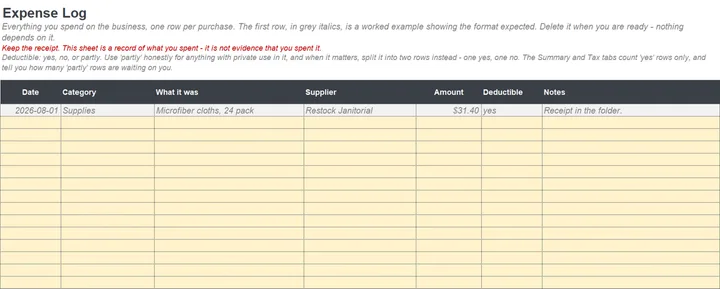
Log income and expenses as they happen, and log which client each job was for. That is all. From those two things the monthly comparison, the client count, the drift and the seasonality all fall out on their own.
Then next August you will not be worried. You will look at the chart, see that August is always like this, and take the week off you have been putting off for three years.
The reframe
A slow month is information about your business, not a verdict on it.
The question is never "is it over." It is "which of the three is this," and that question has an answer sitting in numbers you can collect in fifteen seconds a day.