How Much Should You Set Aside for Taxes?
The single most common cash-flow failure in a small business is not overspending. It is spending money that was never yours, because nothing about it looked different from the money that was.

Nobody withholds anything for you.
That sentence is the whole problem. For anyone who has ever had a job, tax was invisible — a number on a payslip, gone before the money arrived. The amount that hit the bank was yours to spend, and the system was designed so you never had to think about it.
Self-employment removes that machinery entirely and puts nothing in its place. Every dollar a customer pays you lands in one account, looking identical to every other dollar. Some of it is yours. Some of it belongs to the IRS. Nothing about the deposit distinguishes them, and the bank balance will happily let you spend all of it.
What you actually owe on
Two separate things get calculated on your business income, and people routinely plan for one and forget the other.
Self-employment tax. This covers Social Security and Medicare — the parts an employer would have split with you. Because you are both employer and employee, you carry both halves. It works out to roughly 14.13% of net profit once the deductible-half adjustment is taken into account.
Income tax. Federal, and state if your state has one. This depends on your filing status, your bracket, your spouse's income if you file jointly, your deductions, and the qualified business income deduction. It is genuinely personal and nobody can give you a number for it without knowing your situation.
The important word in both is profit, not revenue. You are taxed on what is left after legitimate business expenses, not on what came in. A year with $90,000 of revenue and $34,000 of expenses is a $56,000 year for tax purposes.
This is why expense tracking is not administrative box-ticking. Every deductible dollar you fail to record is a dollar you pay tax on unnecessarily.
The number people use, and why it is a starting point
The common advice is to set aside 25% to 30% of profit. That is a reasonable default and better than nothing, which is what most people do.
But understand what it is. It is a rule of thumb sized to cover self-employment tax plus a moderate federal bracket. If you are in a higher bracket, or your state takes a real cut, it is light. If you have a spouse with withholding that covers some of the household liability, it may be generous.
The honest version is: pick a percentage with whoever prepares your return, then apply it mechanically. The mechanical part matters more than the exact percentage. Twenty-five percent applied every month beats thirty-two percent applied in principle and never in practice.
Make it a transfer, not an intention
Here is the practical habit, and it is the only part of this article that actually changes anything.
Open a second account. Move the money the day it arrives.
Not at month end. Not when you get around to it. The day the payment lands, calculate the set-aside and transfer it out of the account you spend from. It does not need to be a special tax account or anything with a fancy name — it needs to be an account whose balance does not show up when you check whether you can afford something.
This works for a reason that has nothing to do with discipline. You are not fighting temptation; you are removing the money from view. A balance you cannot see is a balance you do not mentally spend. Every system that relies on you remembering that $4,200 of the $16,000 is not yours will fail in a good month, which is exactly when the amount is largest.
If your bank supports automatic rules, use them. If not, a standing habit tied to an event — money in, transfer out — survives better than one tied to a date.
Quarterly payments
If you expect to owe a meaningful amount, the IRS generally wants estimated payments through the year rather than one settlement in April, and underpaying can carry a penalty.
The mechanics of who owes quarterlies and how much are exactly the sort of thing to settle once with a preparer rather than infer from the internet. But note what quarterly payments do to the set-aside habit: they make it non-optional. If the money has to leave four times a year, the account it leaves from needs to have it.
The people who find quarterlies painful are almost always the people who were not setting aside. For anyone moving the money on the day it arrives, a quarterly payment is a transfer between two accounts they already had.
Know the number before you need it
The last piece is visibility. You should be able to answer, at any point in the year, three questions in under a minute:
- What have I actually earned so far?
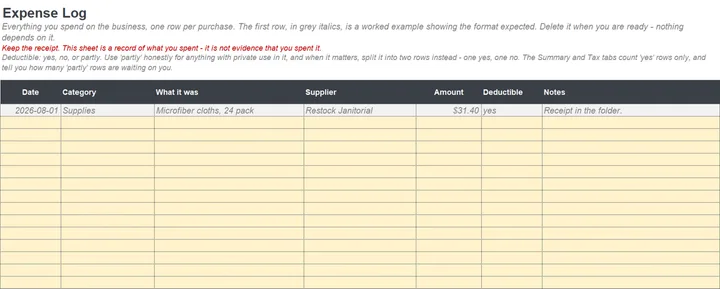
- What have I spent, and on what?
- What is the profit, and what does the set-aside on it come to?
If answering those takes an afternoon of receipt archaeology, you will not ask them, and you will find out in April. If they fall out of a log you keep as you go, you ask them monthly without thinking about it, and April is a formality.
That is really the whole discipline. Log income and expenses as they happen, let the profit calculate itself, apply a fixed percentage, and move the money the day it arrives.
None of this is tax advice, and the specifics genuinely depend on your circumstances — filing status, state, and deductions all move the number. Talk to whoever prepares your return. But set the money aside either way, because the one thing that is true regardless of your situation is that some of what is in your account tonight is not yours.