The Drive Between Jobs Is Costing You More Than You Think
Take the same lawn, the same price and the same mower, and change only the drive between stops. A four-minute drive returns $450.87 in a field day. Fifteen minutes returns $292.37.

There is a particular kind of job that feels like a win and is not.
Somebody calls. They are twenty-five minutes past your last stop, in a nicer neighborhood, and they want the same service you already do. The price is fine. Your Tuesday has room. You say yes, because saying yes to work is what you do.
Six months later you are busier than ever and no better off, and you cannot point to the decision that did it. It was that one, and about nine more like it.
The arithmetic, with one variable changed
Hold everything constant. Same lawn, same price, same mower, same standard of work. Change only the drive between stops.
At a four-minute drive between properties, a full field day returns about $450.87 of take-home.
At fifteen minutes, the identical work returns $292.37.
You did not mow worse. You did not charge less. Nobody negotiated you down. You spent the difference — about 35% of your day's earnings — sitting in a truck.
That is not a rounding error or a modeling quirk. It is the largest single lever most solo operators have, and it is almost never the one they pull.
Two denominators, and only one of them pays you
The reason this stays hidden is that most people track the wrong hour.
Revenue per billable hour is the price divided by the time you spend working on the property. It is the number people quote each other. It is the number that makes a job look good.
Take-home per windshield hour is what is left after costs, divided by the time from leaving the last stop to leaving this one — drive included, unloading included, everything.
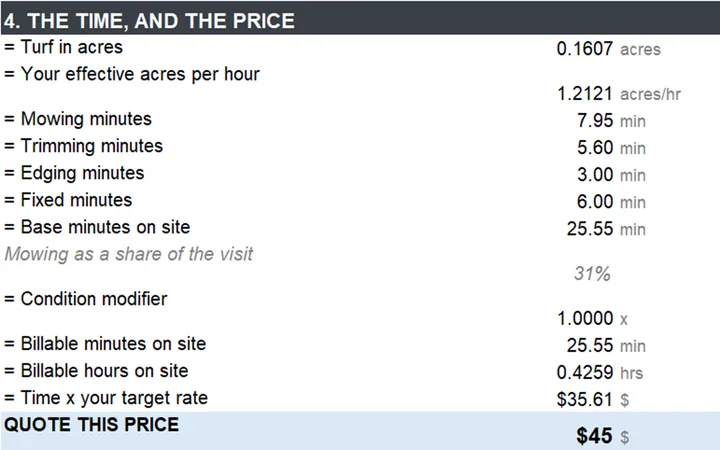
On a real residential route these two can sit a factor of two apart. A worked example: a $45 stop returns $105.66 per billable hour and $50.62 per windshield hour. Same money, same stop. The gap is 52%.
When you evaluate a new job, you almost certainly do it in the first number. You live in the second.
Why this is worse than it looks
Three things compound.
Drive time is unbillable and unavoidable. You cannot charge for it and you cannot skip it. Every minute is pure cost with no offsetting revenue.
It scales with the number of stops, not the size of them. Twelve small properties spread across town means eleven drives. Six large ones in two clusters means four. The small-property route is working significantly harder for the same revenue.
It gets worse as you grow. New clients arrive from wherever they arrive from. Without a rule, a book of business drifts outward year on year, and the average drive creeps up a minute at a time. Nobody notices a minute.
The rules that actually help
Price the outlier for what it costs. If a property is well outside your cluster, it is not the same job at the same price. Either it carries a travel premium that reflects the windshield hour, or it is not a job you want. Quoting it at your standard rate is agreeing to earn a third less for the privilege.
Cluster by day, not by week. You do not need every client in one neighborhood. You need every Tuesday client in one neighborhood. That is a much easier constraint to satisfy, and it captures nearly all the benefit. Ask new clients which day suits them and steer them toward the day that already goes past their street.
Fill a hole before you extend the edge. When capacity opens up, the instinct is to take the next call. The better move is to find work inside the territory you already drive through — the neighbors of existing clients, the street you pass twice a week. Those jobs come with almost no marginal drive at all, which makes them worth meaningfully more to you than an identically-priced job across town.
Be honest about the time of day. Enter the drive at the hour you would really make it, not at six in the morning with no traffic. A twelve-minute hop at seven becomes twenty-two at four-thirty. The route is only as honest as the worst leg on it.
Turning down work is a skill
The hardest part of this is not the arithmetic. It is that "no" feels like scarcity, and scarcity feels dangerous when you are self-employed.
But look at what the numbers say. Turning down a scattered job is not turning down work. It is turning down a job that pays about two-thirds of what it appears to pay, while consuming a full slot that a denser job could have used.
And this is the thing that makes the decision easier: those two jobs are indistinguishable on the quote. Same price, same hours on the property, same customer. The difference lives entirely in a number nobody writes down.
Write it down, and the calls stop being judgment calls.
What to actually do this week
Take your existing route, one day at a time, and record the drive between each pair of stops. Not your impression of it — the actual clock.
Total it. Compare that total to the hours you spent working. Most people are surprised, and the surprise is always in the same direction.
You do not need to reorganize your entire book on the strength of one afternoon's measurement. But once you know that number, the next twenty scheduling decisions get made with the real cost visible, and that is where the change compounds.