A Customer Hasn't Paid. Now What?
One bad debt and one bad habit look identical on a list of invoices. They look completely different once the money is bucketed by how late it is - and they need completely different responses.

The invoice went out three weeks ago. It was due last Friday. Nothing has arrived, and now you are doing the thing every self-employed person does: checking the bank app, deciding it is probably fine, and feeling slightly worse about it every day.
The problem is not usually the money. The problem is that you have no structure for what happens next, so every unpaid invoice becomes a small personal crisis that you handle by feel, at ten at night, in a slightly wrong tone.
Here is a structure.
First, find out which problem you have
Look at every dollar that is owed to you and sort it by how overdue it is:
- Not yet due
- 1 to 30 days late
- 31 to 60 days late
- 61 to 90 days late
- Over 90 days
Count them, and total them, in each bucket.
This one step does more than any script you could send. One bad debt and a bad habit look identical on a list of invoices. They look completely different in buckets.
If you have $4,000 spread evenly across 1–30 and 31–60 days, and it is spread across nine clients, you do not have a customer problem. You have a terms problem, or a follow-up problem, and the fix is a process change.
If you have $3,600 sitting in "over 90" attached to one name, you do not have a process problem. You have one client who is not going to pay without pressure, and no amount of politely re-sending the invoice will change that.
Those two situations feel the same at ten at night. They are not the same, and they need opposite responses.
The number that tells you whether your terms mean anything
Take every invoice you have actually been paid on, and average the number of days between issuing it and the money arriving.
Not the ones outstanding — the ones that landed. Outstanding invoices have no payment date yet, and including them turns the average into a number about the present rather than about your customers' behavior.
Now compare that average to what your terms say.
If your invoices say Net 30 and your average is 47 days, your terms are decoration. They are a sentence at the bottom of a document that nobody, including you, treats as binding. That is worth knowing, because it is fixable and because it is costing you the use of your own money for two and a half weeks per invoice.
Most people have never calculated this number. It usually comes in higher than they guessed.
An order of operations
None of this needs to be adversarial. Most late payment is not malice — it is a purchase order stuck with someone on vacation, an invoice filed in the wrong folder, or a small business owner who is themselves waiting to be paid.
Before it is due. Nothing. Resist the urge. Chasing a not-yet-due invoice trains people to ignore you.
Day 1 to 7 past due. A short, friendly, factual note. Not an apology, not a confrontation. "Invoice 1043 for $480 was due on the 31st — attaching a copy in case it went astray. Let me know if there's anything you need from me." Attach the invoice again. Half of late payments resolve here, because half of late payments are genuinely administrative.
Day 14. Pick up the phone. This is the step people skip, and it is the step that works. An email can be filed. A voice asking a direct question — "is there a problem with the invoice, or is it just in the queue?" — usually produces either the money or the actual reason within a day.
Day 30. Put it in writing with a consequence attached, and mean it. Late fees if your terms carry them. No new work scheduled until the balance clears. This is also the point to stop doing more work for this client, which is the hardest and most important part. Working on while unpaid is how a $500 problem becomes a $3,000 problem.
Day 60 to 90. Formal demand. Depending on the size, small claims court or a collections agency. Both cost you something; a debt older than 90 days that you are still handling by email is usually one you are not going to collect.
The habit that prevents most of it
The reason this is hard is almost never the confrontation. It is that you do not have the information in front of you when you need it.
You cannot chase what you cannot see. If your invoices live as PDFs in a folder, and the only record of what has been paid is your memory plus a bank statement, then finding out who owes you what is a forty-minute job — which means you do it once a quarter, in a panic, rather than once a week in five minutes.
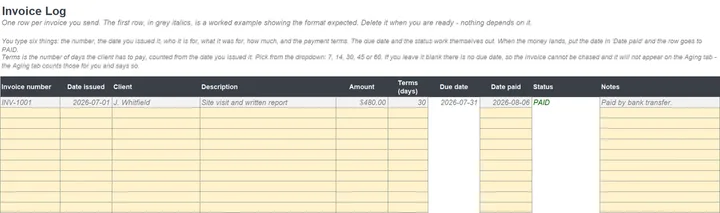
The fix is unglamorous. Log the invoice when you send it: number, date, client, what it was for, the amount, and the terms. When the money lands, put the date in. That is six fields on the way out and one on the way in.
From those seven pieces of information, everything above calculates itself — the due date, whether it is late, how late, which bucket it is in, what your real average days-to-pay is, and what your total outstanding actually comes to.
One thing worth watching
While you are looking at who owes you money, look at who pays you money. Total the year's revenue by client.
If one client is more than about a quarter of your year, that is a risk worth knowing about — not because they will not pay, but because people move, budgets get cut, and businesses close. A single client at 40% of revenue means your income is one phone call away from halving.
That has nothing to do with chasing invoices. But it lives in the same numbers, and you may as well find out while you are in there.