Commuting vs Business Miles
The rule people half-remember is "you can't deduct your commute." True, but the word commute is doing far more work in that sentence than most people realize.

Almost everybody has heard that you cannot deduct your commute. It is true, and it is where most people stop — which is expensive, because the word commute is carrying far more weight in that sentence than they think.
For somebody driving to four job sites a day, most of the driving is not a commute at all. And a meaningful share of what people assume is a commute may not be one either.
The idea underneath the rule
Broadly: travel between your home and a regular place of work is personal. Travel between places of work is business.
That distinction is easy for somebody who drives to one office every day. It gets interesting when your workplace changes four times daily and one of them might be your kitchen table.
The legs almost nobody counts
Start with the part that is not contentious at all, because it is where the money actually is.
Take a typical route day: home → Anderson's → Whitfield's → Okafor's → the supply house → home.
The three legs between job sites are business mileage. So is the run to the supply house. Nobody argues about these, and they are frequently the majority of the day's miles.
Yet when people reconstruct a year in April, they remember the drive out and the drive home and forget the middle entirely. Six hundred four-mile hops do not survive in memory. That gap — not the contested first and last leg — is the single largest source of underclaimed mileage in a route business.
If you take nothing else from this: count the legs between stops.
Where "principal place of business" changes things
The first and last drives of the day are the contested ones, and the pivot is whether your home qualifies as your principal place of business.
Broadly, that turns on whether you use a part of your home regularly and exclusively for the administrative or management work of the business — the invoicing, scheduling, quoting, bookkeeping — and whether there is any other fixed location where you do that work.
For a lot of solo operators there genuinely is no other location. The business is run from a desk at home and performed at client sites. Where that holds, the drives between home and the first and last client of the day can be business mileage rather than commuting.
The words doing the work there are regularly and exclusively, and they are stricter than people assume. A corner of the dining table that is also where the family eats is a harder case than a spare room used for nothing else.
This is exactly the sort of thing to settle once with whoever prepares your return, for your actual situation, rather than to infer from an article. But it is worth raising with them, because it is frequently worth more than any other single line on a small operator's return, and plenty of people never ask.
What is clearly not deductible
- Driving to a fixed regular workplace — if you have one, that leg is commuting
- Personal errands, including in the work truck
- The personal portion of a trip you combined with business
- Getting to and from a job that you drove to purely as a passenger
The combined-trip one catches people. If you stop at the supermarket on the way back from a job, the job legs count and the detour does not.
The record is the whole thing
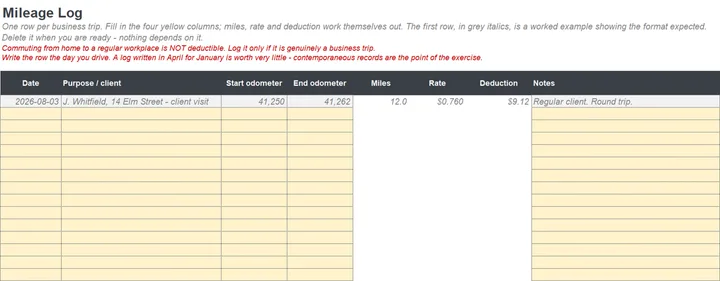
Whatever the rules turn out to be in your case, they only help if you wrote the trip down.
The IRS looks for records that are adequate and timely — a log kept at or near the time of the trip, with the date, the mileage, the destination, and the business purpose. Four things.
A log written in April from a calendar is not that. It may still be accepted, but it stands on much weaker footing, and — the practical point — it is worse. It undercounts, every time, because you are only recording the trips you can prove to yourself and you have forgotten most of them.
Contemporaneous does not mean burdensome. Odometer out, odometer back, a few words about why, before you pull away. Fifteen seconds.
The habit that survives a bad week
Every mileage system fails identically: it works for three weeks, then there is a busy Thursday, and it never recovers.
Two things make it last.
One place, always the same place. Not an app you must remember to open. One file, one row per trip, always in the same spot.
Only type what cannot be calculated. Date, destination, purpose, two odometer readings. The miles, the deduction, the running total and the split by purpose should work themselves out. Every field you compute by hand is one you skip when you are tired — and a skipped field becomes a skipped row, then a skipped week.
Why it matters more than it looks
The deduction reduces net profit, and net profit is what self-employment tax is calculated on — roughly 14.13% — before any income tax at all.
So an unrecorded business mile is not a missed bonus. It is tax paid on money that was never profit.
This is not tax advice, and the home-office and principal-place-of-business rules in particular have real nuance that depends on your circumstances. Ask your preparer. But keep the log either way, because whatever the answer turns out to be, you cannot claim what you did not write down.