One Client Is a Quarter of Your Revenue. That Is Worth Knowing.
The best client you have is also the largest single risk in the business, and the two facts are the same fact. Most people never measure it, because it only appears when the year is totaled in one place.

Your biggest client is your favorite client. They pay on time, they never argue, and the work is steady enough that you plan around it.
They are also the largest single risk in your business, and those are not two separate facts. They are the same fact seen from two directions.
This is not a warning about them. Good clients leave for reasons that have nothing to do with you. People move. Companies get acquired. A building changes management. A budget gets cut by somebody three states away who has never heard of you. The contract ends in a phone call that takes ninety seconds, and none of it was about your work.
Measure it, because you cannot feel it
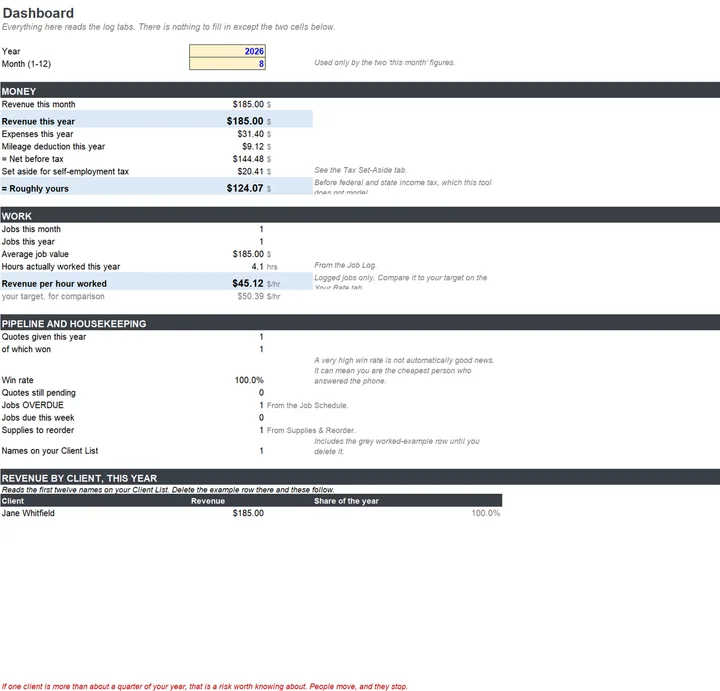
Total the year's revenue by client. Sort descending. Divide each by the total.
Almost nobody has done this, and almost everybody is surprised. Concentration hides from intuition because you experience your business as a sequence of days, not as a distribution. The client you see every week feels like one of many. On paper they are 31% of the year.
Do it once and you will not need convincing.
The threshold that matters
There is no law here, but there is a working rule that holds up well for small service businesses:
Above about 25% from one client, you have a concentration you should be actively managing.
Below that, losing anybody is a bad month. Above it, losing one client means a decision — cut costs, dip into savings, or take work you would normally refuse. That is a materially different kind of business to run, and the difference is not visible in your bank balance until the day it matters.
At 40% you are not running a business with a big client. You are running a subcontracting arrangement with a side business attached, and you should price and plan accordingly.
Why it is worse than the percentage suggests
Three things compound, and none of them appear in the number.
Your schedule is shaped around them. The big client gets the good slots. Their Tuesday is untouchable, so your other work fits around it. When they leave you do not just lose the revenue — you have a schedule built to serve a client who is gone, and the replacement work does not slot neatly into the holes.
Your pricing softens. Volume makes people generous. The large client is frequently on your worst rate, which means the concentration in revenue understates the concentration in hours. Run the same calculation on hours and it often looks worse.
You lose leverage without noticing. Nobody negotiates hard with a client who is a third of their income. Scope creeps, the price increase gets deferred another year, the awkward conversation does not happen. That is a real cost and it never shows up as a line item.
Reducing it without losing anybody
The instinct is to fire the big client. Do not. The goal is not less of them; it is more of everything else.
Grow the denominator. Concentration falls when the rest of the business grows, which is the version of this fix that costs you nothing. Two new mid-sized clients move 31% to 24% without a single difficult conversation.
Fix the pricing on the big one. If they are on your worst rate, they should be on your standard rate, and the annual review is when that happens. This raises revenue and reduces the hours concentration at the same time. It is also the conversation you have been avoiding, which is a decent sign it is the right one.
Diversify the type of work, not just the count. Five clients in one office park is not five clients. If the park changes its facilities contractor, you lose all five. Concentration lives in whatever they have in common — one industry, one landlord, one decision-maker.
Know when the contract renews. For commercial work, put the renewal date somewhere you will see it three months out, not three weeks. The time to be adding clients is before a renewal, not after a non-renewal.
What to keep an eye on
Two numbers, once a quarter:
- Top client as a share of revenue. The headline.
- Top three as a share of revenue. Often more revealing. One at 20% looks fine; three at 20% each is 60% of the business resting on three phone calls.
And one more that is easy to overlook: how many clients on your list have not been served recently. If you have forty names and thirty-one are on a schedule, nine people consider themselves your customer and are not booked for anything. Some are genuinely one-off. Some are drifting, and drifting clients are how concentration gets worse without any single event you could point to.
The point of measuring it
Knowing your concentration does not stop a client leaving. It changes what you do in the eighteen months before they do.
It tells you when to take on work you would otherwise turn down, when a price increase can wait, and when it cannot. It turns "I should probably get more clients" into a number with a direction.
None of it is visible from memory. It only appears when the year is totaled in one place — which is, in the end, the whole argument for writing any of this down.