The Business Expenses Most People Forget to Deduct
The expenses people miss are not exotic. They are ordinary costs paid on a personal card, in a hurry, and never written down - and they add up to more than most people would guess.

Nobody misses the truck payment.
The expenses that go unclaimed are small, ordinary, and paid in a hurry — usually on a personal card, usually while doing something else. They never enter the books because there was no moment at which entering them was the obvious next step.
Individually they are trivial. In aggregate they are frequently four figures a year, and every dollar of them is a dollar you paid tax on for no reason.
The ones that get missed
Supplies bought on a personal card. You ran out of bags on a Tuesday and stopped at the hardware store on the way home. It came out of the personal account because that is the card in your pocket. It is a business expense. It is almost never recorded.
Your phone. If you use it for the business — and you do — the business-use portion is deductible. Most people either claim nothing because working out a percentage feels fiddly, or vaguely intend to sort it out later.
Software and subscriptions. The scheduling app, the invoicing tool, the cloud storage, the accounting software. Small monthly amounts on autopay are the single most forgotten category, precisely because they never require a decision.
Bank and payment processing fees. Card processing takes a percentage of every transaction. Over a year that is a real number, and it is a cost of doing business.
Insurance. General liability, commercial auto, bonding. People remember the annual bill and forget it is deductible.
Licenses, permits, and registrations. Annual, easy to forget, fully deductible.
Professional fees. Your accountant. A lawyer if you needed one for the business. The cost of preparing the business portion of your return.
Advertising. Business cards, yard signs, a website, vehicle lettering, the boosted post you ran in March.
Trade education. Courses, certifications, industry publications that maintain or improve your skills in the work you already do.
Small equipment. The vacuum, the extension cord, the ladder, the replacement blades. Larger purchases may be depreciated rather than deducted outright, which is exactly the sort of thing to hand to a preparer — but it has to be recorded before anyone can decide how to treat it.
Uniforms and protective gear. Gloves, boots, branded shirts. Clothing rules have real nuance — ordinary clothes are usually not deductible even if you only wear them for work — but protective and branded items generally are.
Mileage. The largest one for most route businesses, and covered on its own because it deserves it.
Why they get missed
There are only three reasons, and none of them is ignorance of the rules.
It was paid from the wrong account. Personal card, no business record. This is the biggest single cause, and it is entirely mechanical.
It is on autopay. A $14 subscription that renews silently never crosses your desk. It appears on a statement you skim.
It was small. Nine dollars felt beneath recording. Two hundred instances of nine dollars did not.
The two habits that fix most of it
Separate the accounts. One business checking account and one business card, used for everything business and nothing else. This is the single highest-leverage administrative decision a small operator makes, and it costs nothing.
It is not about tidiness. It converts the problem from remembering to reading a statement. Every line on that statement is a business expense by construction. You are no longer trying to recall whether the hardware store trip in March was for a job — the account tells you.
When you do pay from a personal card because that is what was in your pocket, log it the same day and reimburse yourself from the business account. Now it exists in both places.
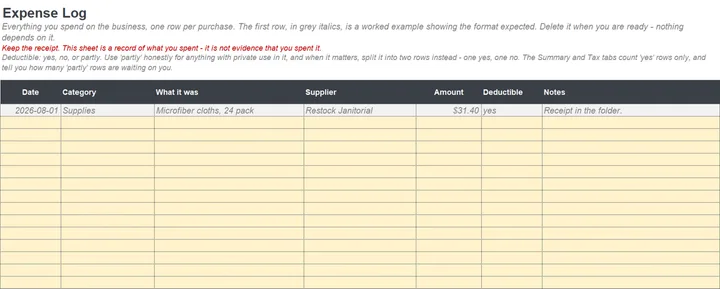
Log it in the same motion as spending it. Not weekly, not monthly. Date, vendor, category, amount — four fields, fifteen seconds, in the truck before you drive away.
Every system that depends on a catch-up session fails the same way: it works until a busy week, and then it never recovers, and the gap is exactly the period you were spending the most.
Categories exist for you, not for the tax office
Do not agonize over categorization. A small number of consistent buckets — supplies, fuel, equipment, insurance, software, professional fees, advertising, other — is enough.
Their real value is not the return. It is that in November you can see that supplies have run 40% above last year and ask why. That question is worth more than the deduction.
What this is not
This is not tax advice, and several items above carry genuine nuance — the home office rules, the clothing rules, the line between an expense and a capitalized asset, what counts as maintaining versus qualifying for a new trade. Those depend on your circumstances and are worth a conversation with whoever prepares your return.
But the nuance is downstream of the record. A preparer can tell you how to treat a cost. Nobody can tell you how to treat one you did not write down.
Remember what the deduction actually does: it reduces net profit, and net profit is what self-employment tax is calculated on before any income tax at all. An unrecorded expense is not a missed opportunity for a benefit. It is tax paid on money that was never profit.