What to Do About a Chargeback
The money is taken back first and the argument happens afterwards. That reversal of order is what makes chargebacks feel so unfair, and it is also what tells you how to prepare.

You get an email from your payment processor. A job you did seven weeks ago has been disputed. The money is already gone from your balance, and there is a fee on top.
The first thing to understand is the order of events, because it explains everything about how this works. The money is taken back first and the argument happens afterwards. You are not being asked whether you agree. You are being told it has happened and invited to contest it.
That is genuinely unfair-feeling, and it is also the fact that tells you how to prepare.
What it actually is
A chargeback is the cardholder going to their bank, not to you, and asking for the transaction to be reversed. The bank pulls the funds pending review.
It is a different thing from a refund. A refund is you deciding to return money. A chargeback is a claim made over your head, and it carries a fee whether or not you eventually win.
Reasons vary: the service was not as described, it was not provided, the charge was not authorized, or the customer does not recognize the transaction. That last one is more common than people expect and is often not malicious at all.
The first thing to do is call the customer
Before you file anything. Before you write a defense.
A large share of disputes on small service jobs are not accusations. They are confusion — a spouse who did not recognize a charge, a business name on the statement that does not match the person who did the work, a card statement read in a hurry.
One phone call resolves a meaningful proportion of these, and it resolves them better than winning would. The customer can withdraw the dispute with their bank. You keep the money, you keep the relationship, and you avoid a process that costs you time either way.
Be calm about it. Ask what happened. Do not lead with an accusation, because a decent fraction of the time there is nothing to accuse anybody of.
If it is genuine, decide whether to fight
Two things to weigh, and they are not the same weight for every job.
How good is your evidence? Chargebacks are won on documentation, not on being right.
Is the amount worth the hours? A $140 dispute may cost you more in time and stress than the money. That is a legitimate calculation and not a defeat.
If you do contest it, note the deadline. Processors give a limited window and it is short. Missing it forfeits the case regardless of the merits.
What evidence actually helps
The whole game is showing the service was agreed, delivered, and matched what was described.
- A written record of what was agreed — scope, price, date. Even a text thread.
- Proof it was delivered — before-and-after photographs with timestamps, a signed sheet, a completion message.
- The communication trail — the quote, the acceptance, anything afterwards. A "thanks, looks great" text is worth a great deal.
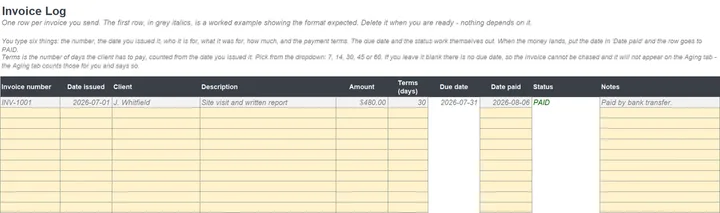
- The invoice, showing what was charged and for what.
- Your terms, if the dispute is about a cancellation or a deposit and you had stated a policy.
- Evidence of authorization — for a card taken in person, the transaction record.
Notice that all of it is created before the dispute exists. That is the actual lesson here. You cannot assemble this after the fact; you either have it or you do not.
The habits that prevent most of them
Make your business name recognizable on statements. Check what actually appears. If your legal entity is something the customer has never heard, that alone generates "I don't recognize this charge" disputes. Most processors let you set a clear descriptor. Do it.
Photograph completed work. Not for every job, but for anything substantial. It takes thirty seconds and it is the single most useful piece of evidence in a service dispute — the customer's memory of how the house looked resets the moment it is clean.
Get the scope in writing. A text saying "confirming Thursday, kitchen and both bathrooms, $180" is enough. Most disputes about quality are actually disputes about expectation.
Charge close to the work. A card charged on the day is rarely disputed. One charged three weeks later, after the memory has faded, is a different matter.
Handle complaints before they become disputes. A chargeback is very often an unhappy customer who did not think complaining directly would work. If somebody raises a problem, answering the same day costs you far less than a dispute does — even if you end up refunding.
Refund first when you know you are in the wrong. A voluntary refund is cheaper than a chargeback: no fee, no dispute ratio, no relationship damage. Deciding to refund is not losing.
Keep the record afterwards
However it ends, write it down against the client: what happened, the amount, the reason given, the outcome.
One dispute is bad luck. A pattern is information. If disputes cluster around one type of job, that is a scoping problem. If they cluster around jobs charged weeks late, that is a process problem. If the same customer does it twice, that is a customer you know something about — and the only way that knowledge protects you is if it is attached to their name when they call back in a year, cheerful, wanting a quote.
The one to remember
You cannot win a chargeback with a good argument. You win it with documents that existed before the argument started.
Which means the work is not in the dispute. It is in the ten seconds it takes to photograph a finished job and the thirty seconds it takes to confirm the scope in a text.