Should You Take Card Payments?
The argument against cards is a number you can see. The argument for them is a number you cannot, which is why most people get this decision backwards.
The objection is always the same, and it is always a specific number: they take three percent.
That is true, and it is the wrong comparison. Three percent is what cards cost. The question is what not taking them costs, and that number is invisible, which is why it loses an argument it should usually win.
What slow payment actually costs
Money you are owed is money you cannot use. If your average invoice takes 40 days instead of 5, you are extending 35 days of free credit on every job you do.
Work an example. $6,000 a month of invoicing, average 40 days to payment. At any moment you are carrying roughly $8,000 of other people's obligations — money you earned, spent fuel and time to produce, and do not have.
If taking cards moves that average to 10 days, you free up around $6,000 of working capital permanently. That is the difference between buying equipment when you need it and waiting, or between covering a slow February and not.
Against that, 3% of $6,000 a month is $180.
The fee is a known, priced, predictable cost. Slow payment is an unpriced, unpredictable one that also consumes your attention — every hour spent chasing is an hour not earning, and the chasing is the part of self-employment people hate most.
Where cards clearly win
Residential work. Households do not have accounts payable. They have a phone, and they pay things when paying is easy. A link they can tap while standing in the kitchen converts far better than bank details they have to enter later, and "later" is where invoices go to die.
At the point of completion. The single best moment to be paid is when the work is finished and the customer is pleased. Being able to take payment there, in the driveway, removes the entire chasing problem for that job. Nothing else you do gets close to that.
Anything under a few hundred dollars. The fee is small in absolute terms and the administrative cost of chasing is not proportional to invoice size. Chasing a $140 invoice costs the same as chasing a $1,400 one.
New clients. No payment history, no reason to extend credit.
Where they are less obviously worth it
Large commercial invoices. A 3% fee on $4,000 is $120, and most commercial clients pay by ACH or check on a schedule anyway. Bank transfer costs pennies. Offer cards, but do not push them here.
Reliable recurring clients on ACH. If somebody has paid by bank transfer on time for two years, you are solving a problem you do not have.
What it actually costs
Look at the whole picture rather than the headline rate.
- Per-transaction percentage plus a flat fee. The flat fee matters disproportionately on small jobs.
- Higher rates for keyed-in or invoiced payments than for tapped cards in person.
- Monthly minimums or terminal rental, on some providers. For a small operator, avoid these — pay-as-you-go pricing with no monthly floor is widely available.
- How fast the money actually lands. Next business day is common; some providers hold longer, and a provider that is cheap but slow has undone the point.
The surcharge question
You will be tempted to add the fee to the bill.
Be careful. The rules on surcharging cards vary by state and by card network, and some prohibit it or cap it. A cash discount is often treated differently from a card surcharge even though they are arithmetically identical, which tells you how much the framing matters legally. Worth checking rather than assuming.
There is also a commercial argument against it, separate from the legal one. Surcharging reintroduces friction at the exact moment you were trying to remove it, and it makes the customer think about the price again after they had stopped. For a small fee on a small job, that trade is usually bad.
The cleaner approach: build the average cost into your rate. If 60% of your work goes on cards at 3%, that is roughly 1.8% across the business. A price rounded up slightly covers it and nobody has a conversation about it.
Do not let it hide the record
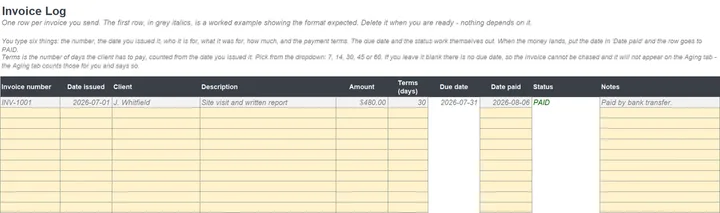
One trap worth naming. When payment happens instantly at the job, it stops being an invoice — and people stop logging it.
Then the year has a hole in it. Some jobs are in the invoice log, some exist only as deposits in a bank feed, and reconciling the two in April is exactly the archaeology you were trying to avoid.
Log the job either way. Whether the money arrived in three seconds or thirty days, the record of what you did, for whom, and for how much is the same record — and it is the one that tells you your real average days-to-pay, which is the number that told you to take cards in the first place.
The short answer
Take cards for residential work, for payment at completion, for small jobs and for new clients. Offer them for commercial work but keep ACH as the default there.
And compare the right two things. The fee is not the cost of taking cards. It is the price of not carrying the alternative.