Should You Take a Deposit?
A deposit is not a way of being paid earlier. It is protection against two specific risks, and if a job carries neither of them you are adding friction for nothing.

The advice usually arrives as a rule: always take a deposit. It is well meant and it is wrong about half the time.
A deposit is not a general-purpose good idea. It is protection against two specific things, and asking for one on a job that carries neither adds friction to your sale for no benefit at all.
The two risks it actually covers
Money you have to spend before you get paid. If a job requires you to buy materials, rent equipment, or pay somebody before any revenue arrives, you are funding the customer's project out of your own account. If they cancel halfway through, you are holding the cost.
A slot you cannot resell. If you block out three days for a deep clean and they cancel on the morning of the first, those days are gone. You cannot fill a Tuesday on Tuesday. The deposit is not compensation for hurt feelings; it is compensation for capacity that had a market value and no longer does.
That is the whole list. If a job has no upfront cost and the slot is easy to refill, a deposit is protecting you against nothing.
Where it usually is not worth it
Recurring maintenance work. Fortnightly lawn care, weekly office cleaning, a regular house. You have no material outlay, and if somebody cancels one visit the loss is one visit. Asking for a deposit here makes a simple arrangement feel like a contract negotiation, and some prospects will just call somebody easier.
Small one-off jobs. A two-hour job with $15 of supplies does not need a deposit. The administrative cost of collecting, tracking, and reconciling it is a real fraction of the job's profit.
Established clients. Somebody who has paid you nineteen times is not the risk you are guarding against. Asking them for a deposit on the twentieth job reads as distrust, and it is the sort of small insult that loses good clients quietly.
Where it clearly is
First job with a new client, at size. Not because they seem untrustworthy — because you have no history and the exposure is real.
Anything with materials or rented equipment. The deposit should at minimum cover what you have to lay out. This is not a negotiating position; it is arithmetic.
Multi-day work that blocks the schedule. The slot is the asset.
Anything the customer described as urgent. Urgency is a genuine signal, and it cuts both ways. Some urgent jobs are people in a real bind. Some are people who have already fallen out with the last contractor. A deposit sorts one from the other at no cost to you.
How much
For materials-driven work: enough to cover your outlay, plus a little. If your supplies come to $400, a $500 deposit is defensible and easy to explain.
For labor-driven work: somewhere between 25% and 50%. Half is normal on larger jobs and reads as standard rather than suspicious.
Above about half, expect resistance and expect to deserve it — at that point the customer is financing you, and they know it.
Keep the number explainable. "Half up front, half on completion" needs no defense. "Thirty-seven percent" invites a question you do not want to answer.
Say it early, and say it as a policy
The mistake is not asking for a deposit. It is asking for one late.
If it comes up in the quote — one line, stated as how you work — it is a term. If it appears after they have said yes, it is a new condition, and it changes the emotional register of the whole thing.
Booked jobs take a 50% deposit, with the balance due on completion.
That is it. As a policy it is unremarkable. As a surprise it is a red flag.
Do not let the deposit hide the balance
Here is the trap almost nobody sees coming, and it is worth more than the rest of this article.
Deposits make your cash position look better than it is. Money arrives before the work, so the account is healthy, and the balance owed afterwards feels less urgent because you have already been paid something.
Balances go unchased far more often than whole invoices. The pressure that makes you follow up on an unpaid job is missing, because you were not unpaid — you were half paid, and half paid feels fine right up until it is a year later and you never collected the rest.
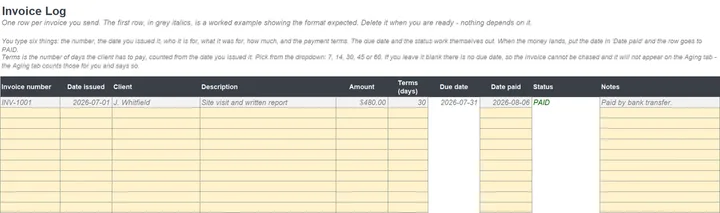
So log both halves as separate amounts due, with their own dates. The deposit is not the payment. The balance is an invoice like any other, and it belongs on the same overdue list as everything else.
If your record of a job is one line that says "paid deposit," you will lose balances, and you will lose them from the largest jobs you do.
The honest summary
Take a deposit when you have money at risk or a slot at risk. Skip it when you have neither. State it in the quote, keep the number round, and track the balance as its own live debt.
And notice which way the question actually points: if you find yourself wanting a deposit on almost every job, that is usually not a deposit problem. It is a terms problem, or a client-selection problem, and a deposit is treating the symptom.