Getting Paid by Commercial Clients
A homeowner decides to pay you. A company processes you. Those are completely different things, and most first commercial invoices are late for reasons that have nothing to do with willingness.

The first commercial invoice you send will probably be late, and it will not be because anybody decided not to pay you.
A residential client makes a decision. A company runs a process — and processes reject things for reasons that would never occur to you. Understanding that shift is most of the job.
The invoice has to survive a stranger
Your invoice does not go to the person who hired you. It goes to accounts payable, where somebody who has never met you and does not know what you did decides whether it can be entered into a system.
They are not evaluating your work. They are checking whether it matches something already in the system, and if it does not, the default is to set it aside and wait for somebody to ask.
That is why commercial invoices die quietly. Nobody rejects them. They just never enter the queue.
The PO number, and why it decides everything
Many companies issue a purchase order before work happens. It authorizes a specific amount for a specific thing, and it exists in their system before your invoice arrives.
If they use POs, your invoice must carry the number. Without it there is nothing to match against, and it will sit until somebody chases it — which is you, three weeks later, discovering that a field was missing.
Ask during the sales conversation, not after the first invoice. One question:
Do you issue a PO for this, and is there a number I should put on invoices?
That single question, asked early, prevents more late payment than any follow-up script.
While you are there, ask two more: where should invoices be sent, and when is the payment run. The billing address is frequently not the site address and frequently not the person you have been talking to.
Terms mean something different here
"Net 30" in a commercial context does not mean thirty days from when you did the work. It means thirty days from when they accepted the invoice — which might be a week after you sent it, if it sat in an inbox.
Payment runs are usually weekly or twice monthly. An invoice that misses Tuesday's run waits for the next one regardless of what the due date says. That is not anybody being difficult; it is how the machinery works.
The practical consequence: send invoices immediately and to the right address. Two days of your own delay can become two weeks of theirs.
For a first commercial contract, thirty days after the first month of service can mean sixty to seventy-five days from your first shift to your first payment. Budget for that gap before you sign, because you will be buying supplies and possibly paying somebody throughout it.
What to put on it
Everything a stranger needs to match it without asking anybody:
- The PO number, if there is one
- Invoice number, sequential
- Issue date and due date, both explicit
- The service period — "cleaning services, September 1–30" — because that is what they are matching to
- The site, if the company has more than one
- One unmistakable total
- How to pay — bank details for ACH, or whatever they use
- Your contact details
Every missing field is a question, and a question is at minimum one payment cycle.
Who to call
When it is late, calling the person who hired you is the slow route. They will forward it, eventually.
Call accounts payable directly. Ask one specific question:
I'm checking on invoice 1043 for the September service — has it been entered, and is it scheduled for a payment run?
That question has three possible answers and all of them are useful. It is in and scheduled — fine, wait. It was never received — resend now. It is on hold for a missing PO or a mismatch — fix it today.
Nobody at AP is offended by this call. It is the normal traffic of their job, and being the vendor who asks clearly is a small advantage.
Being first in the queue
When cash is tight, a company decides who to pay first. Three things move you up.
A clean invoice. Nothing to query means nothing to postpone.
A relationship with AP. A name and a direct line beats a general inbox every time.
Costing something to delay. Late fees on commercial accounts are normal commercial practice and, applied consistently, they work — not as revenue, but because suppliers who charge interest get paid before suppliers who do not. Check your state's limits on what you can charge, state it on the quote and every invoice, warn once with a date, and then actually apply it. A fee you print and never charge is a written statement that your terms are decoration.
No new work until the balance clears is the other lever, and for a recurring contract it is often stronger than a percentage.
The record that makes it possible
None of this works from memory. Across twelve buildings you will not remember which client uses POs, which pays twice monthly, who the AP contact is, or which of last month's invoices went out on the 3rd.
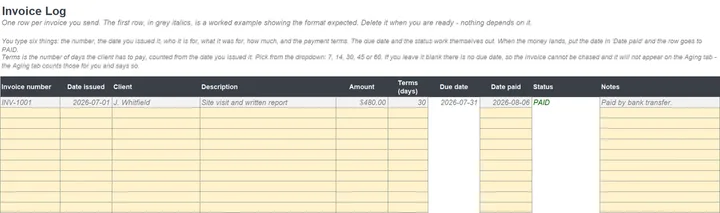
Log it when you send it: number, date, client, service period, amount, terms. Then overdue status calculates itself instead of depending on you noticing, and the monthly chase is a five-minute task with a list rather than an afternoon of reconstruction.
Track your average days-to-pay on the invoices that actually got paid, per client. Commercial clients are consistent — a company that pays in 42 days pays in 42 days every time. Once you know that, you stop worrying on day 31, and you know exactly which client is the genuine outlier.